David Goggins: Can't Hurt Me
He sprayed for cockroaches at night. He weighed almost 300 pounds. Then he chose the hardest road he could find.
In November 2005, on a flat running track in San Diego, a Navy SEAL sat down in a blue folding lawn chair. It was the middle of a 24-hour race. He had run about 70 miles. Before that day, the longest run of his life was about 20.
He had not trained for this. He had signed up the week before. He brought crackers and a sports drink and a lot of pride.
Now his body was shutting down. His feet were bleeding. He was so exhausted that he could not get out of the chair to walk to a portable toilet 20 feet away. He had 30 miles to go.
Most people would have quit. It would have been the smart thing to do. But David Goggins did not think of himself as a smart runner. He thought of himself as a man who had spent too much of his life quitting.
So he sat in the chair and started to go through his memories, one by one. The father who had beaten him. The kids who had called him names. The school he had cheated his way through. The training he had survived. He reminded himself that he was still here.
Then he got up.
He finished 101 miles in 18 hours and 56 minutes. Afterward his kidneys were in trouble, and he was in terrible shape for days. But he had done it. That race qualified him for something even harder.
This is the story of a boy who says he was once the weakest person he knew, and who spent his life trying to become the toughest. Much of it comes from his own telling in his books and interviews. It is raw, painful, and not always pretty.
Paradise Road
David Goggins was born on 17 February 1975 in Buffalo, New York. His family lived on a street called Paradise Road.
To the outside world, his father looked like a success. He owned a roller skating rink and a bar. He drove nice cars. Goggins has said that behind the doors of their home, things were very different.
In his telling, his father was violent. He beat Goggins's mother. He beat David and his older brother, often with a belt. The boys had to work at the skating rink late into the night, handing out skates and cleaning up, then go to school exhausted. Goggins has said he often did not make it to class at all.
He remembers watching his mother being hurt and feeling helpless. He says the fear and the noise of that house stayed in his head for years.
Escape to Indiana
When David was about eight, his mother made a plan. One day, while his father was busy, she packed what she could into a car and drove away with David. They ended up in Brazil, Indiana, a small town near where her family lived.
They were poor. For a time, they lived in low-rent housing and got by on very little. His mother worked hard and went back to school.
Goggins has said his mother was working three jobs, and that for part of that time they lived in a place that cost seven dollars a month. She was so busy trying to survive that she did not always see how much he was struggling. He has also said that if she had not left Buffalo, he believes he would have ended up visiting her in prison.
He found some relief in sports. He played basketball in high school and loved the feeling of being part of a team. But even there, he says, he felt he was pretending to be someone he was not.
Goggins was safe from his father. But a new kind of struggle began. There were very few Black families in town. He says he was called racist names often. Once, he found a drawing in his notebook of a stick figure hanging from a noose, with a threat written beside it. He took it to the principal and says he got little help. He has also said that in the 1990s the Ku Klux Klan marched in a Fourth of July parade in the town.
Then tragedy struck again. His mother's fiance, a kind man who had become like a father to David, was murdered.
The kid who faked it
At school, David fell further and further behind. He struggled to read. He has said he copied other students' work and cheated on tests just to get by. He built a tough outer shell, with baggy clothes and a cool attitude, to hide how scared and lost he felt.
He later called it wearing a costume. Everyone saw the costume. No one saw the kid inside it.
He says there was a moment near the end of high school when the costume stopped working. He was close to not graduating. He wanted to join the Air Force, but he failed the military entrance test, called the ASVAB.
One night, he looked at himself in the bathroom mirror. He did not like what he saw. He says he finally admitted the truth: his problems were not only his father, or the town, or the teachers. They were also him.
The accountability mirror
That night he started a habit that later became famous. He took small sticky notes and wrote goals and hard truths on them. He stuck them on the mirror. Read a book. Study for the test. Stop lying.
He called it the accountability mirror. Every day he had to face it.
He started studying for hours. He says he had to learn to read all over again, word by word, so he could really understand the test instead of guessing. His friends noticed he had changed. The second time, he passed.
The way he studied became a pattern for the rest of his life. If something was hard for him, he did not look for a shortcut. He did it more. When a page of the study guide made no sense, he read it again and again until it did, even if that took an entire evening. He has said he was not smarter than anyone else. He simply stopped running away from what he could not do.
He joined the United States Air Force.
The man who fell 3,000 feet
When Goggins was a teenager, he went to a camp run by the Civil Air Patrol, a program for young people interested in flying and the military. One of the speakers was an Air Force pararescueman named Scott Gearen.
Gearen had a story that sounded impossible. During a jump, another team member still in free fall had crashed through his parachute. Gearen fell about 3,000 feet and hit the ground at over 100 miles an hour. He was badly injured, and medics had to put an airway in his throat so he could breathe. He survived, recovered, and went back to work.
The teenager sat in the crowd and stared. Gearen told his story, then dropped down and did push-ups and flutter kicks. To Goggins, he looked like a real-life action hero.
Goggins went looking for him. He says he ran up a phone bill of about 500 dollars calling Air Force bases, which made his mother furious. He finally found Gearen working as a scuba instructor in Key West, Florida, and asked if he could stay with him for a week. Gearen said yes.
For a week, Goggins sat around while Gearen taught, then went running with him and followed him into the ocean to hunt for lobster. Goggins was scared to death of the water. But Gearen went in, so he went in. He left with one goal. He wanted to be a pararescueman.
Afraid of the water
Pararescuemen, often called PJs, are elite airmen who jump from planes and helicopters to save downed pilots and injured people.
There was one big problem. He was terrified of water. He had learned to swim late and was not a strong swimmer. Pararescue training included brutal water drills. Trainees were tied up and made to float, sink, and recover.
He says he wanted to quit every night. Then a blood test showed he carried the sickle cell trait, which can raise health risks under extreme training. He has admitted he used it as a way out. He left the pararescue program.
He spent the rest of his Air Force time, from about age 19 to 24, in another job called Tactical Air Control Party. It was a respected role. But he says that inside, he felt he had quit on his dream.
Nearly 300 pounds
After the Air Force, Goggins went home to Indiana. He took a job with a company called Ecolab, spraying for cockroaches and pests in restaurants overnight. He worked from about 11 at night to 7 in the morning and earned about 1,000 dollars a month.
He ate a lot. He barely exercised. By age 24, he weighed almost 300 pounds.
He says his last stop each night was a Steak 'n Shake, where he would finish the job and get a milkshake. He hated his life, and he hated himself.
The documentary at midnight
One morning after work, he turned on the television and saw a documentary about Navy SEAL training. It followed a class through Hell Week, the most brutal part of Basic Underwater Demolition/SEAL training, known as BUD/S.
He watched young men shivering in freezing surf, carrying boats over their heads, getting no sleep for days. Most of them quit. At the end, only a small group was left. Their commanding officer gave a speech about men who refuse to accept mediocrity.
Goggins says he felt small. He knew he was the kind of person the officer was talking about, the kind who had quit. He also felt something else. He wanted to be one of those men.
106 pounds in less than three months
He started calling Navy recruiters. Most of them laughed. He was overweight, he had prior service, and he was 24.
Then one recruiter, named Steven Schaljo, said he would help. But there was a catch. To get into the class that was open, Goggins had to meet the Navy's weight limit fast. He had to lose about 106 pounds in less than three months.
He quit his job. The first time he went for a run, he made it about a quarter of a mile. He came home and cried.
The next day he went again. He started working out for hours every day. He rode a stationary bike, swam, ran, and did hundreds of push-ups and pull-ups. He ate very little. He studied for the Navy's entrance test at the kitchen table.
He hit his weight. He passed the test. He got into BUD/S.
Three Hell Weeks
BUD/S is one of the hardest military training programs in the world. Most people who start it do not finish. The worst part is Hell Week: about 130 hours of nonstop training, with maybe two hours of sleep in total.
During Hell Week, trainees run on soft sand in wet uniforms. They lie in the freezing Pacific surf, arms linked, while waves crash over their heads. They carry heavy rubber boats on their heads everywhere they go, and lift logs as a team until their arms shake. Instructors shout, and a brass bell waits for anyone who wants to quit. Ring it three times, and the pain is over. So is the dream.
In his first class, Goggins got double pneumonia during Hell Week and was pulled out. He was "rolled back," which meant he had to start over from day one with a new class.
In his second class, he made it through Hell Week, but with a broken kneecap, he says. He kept training on it until he could not. He was rolled back again.
The instructors told him he had one last chance. His third Hell Week came about a year after his first. He started it with stress fractures in his shins and other injuries.
To keep going, he wrapped his shins and feet in thick socks and duct tape so the bones would be held tight. He says he ran on those broken legs until the pain went numb.
During that year he also developed an idea he later called the cookie jar. When things got unbearable, he reached back in his mind for hard things he had already survived, like his childhood, the racist insults, and losing all that weight. Each memory was a cookie. It reminded him he was still standing.
He also invented a mind game he called taking souls. When instructors tried to break him, he pushed even harder, so that they would be the ones wondering how he kept going. He says it turned the fight around in his head. Instead of being the victim, he felt like the hunter.
That year was also marked by loss. Goggins has said that during his third Hell Week, a fellow trainee died, and the week ended early. It was a grim reminder of how far the training pushes the human body.
In 2001, David Goggins graduated with BUD/S Class 235. He had gone through Hell Week three times in about a year.
Ranger School
Becoming a SEAL was not enough for him. He wanted more hard things.
He volunteered for the Army's Ranger School, a grueling leadership course known for starving and exhausting its students in forests, mountains, and swamps. It was unusual for a Navy SEAL to attend. Goggins says he finished as the top enlisted graduate, called the Enlisted Honor Man.
Ranger School is split into phases in the woods, the mountains, and the swamps. Students carry heavy packs, lead patrols on little food and sleep, and are graded on their leadership while they are exhausted. Many students have to repeat phases. Goggins went through in winter, when the mountain phase is especially cold.
Over time, people began to describe him as one of the only people to complete SEAL training, Army Ranger School, and Air Force Tactical Air Control Party training. The label stuck to him for years.
He deployed overseas with SEAL units. He does not talk much in public about his combat missions, and much of that work is classified. What he does talk about is what happened in June 2005.
Red Wings and a lawn chair
In June 2005, during an operation in Afghanistan called Red Wings, a small team of Navy SEALs was ambushed in the mountains. A helicopter sent to rescue them was shot down. Nineteen American special operations troops died, including SEALs Goggins had trained with. Only one member of the original team, Marcus Luttrell, survived.
Goggins has said that two of the men who died, Michael Murphy and Matthew Axelson, had been in his BUD/S classes. He had trained beside them in the same cold surf. Their deaths hit him hard.
Goggins wanted to help the families of the fallen. He decided to raise money for the Special Operations Warrior Foundation, which pays for college for the children of special operations troops killed in the line of duty.
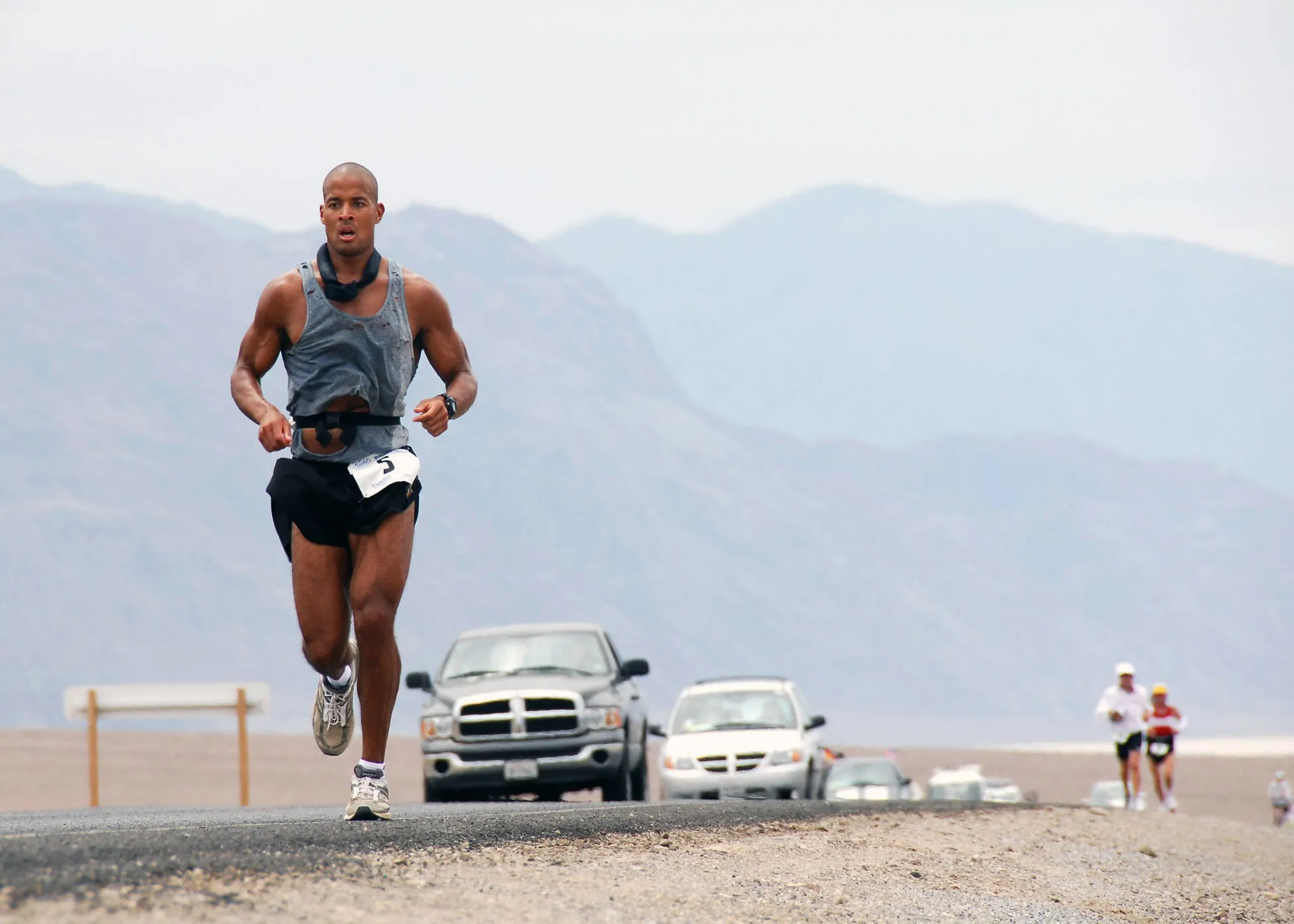
He figured people would give more money if he did something painful. So he searched online for the hardest footraces in the world. The top result was the Badwater 135, a race of 135 miles through Death Valley in the middle of summer, where the temperature can pass 120 degrees Fahrenheit.
He called the race director, Chris Kostman. Kostman asked if he had ever run 100 miles in less than 24 hours. Goggins said no. His longest run was about 20 miles. Kostman told him he needed to prove he could do it before he could enter.
That is how he ended up in the lawn chair in San Diego, with 30 miles to go and a body falling apart. His wife at the time was there as his crew. At mile 81, when she told him he was too slow to make the cutoff, something clicked. He says he ran the last 19 miles without stopping.
Badwater
In July 2006, Goggins lined up for Badwater. The course starts below sea level in Death Valley and ends high on the slopes of Mount Whitney. Runners wear white clothing to reflect the sun. Some soles melt on the hot road.
He finished fifth overall.
The race begins at Badwater Basin, about 282 feet below sea level, the lowest point in North America. It ends at Whitney Portal, at about 8,300 feet. In between are 135 miles of blacktop, salt flats, and long climbs. Goggins had been training in a sauna and running in heavy clothes to get ready for the heat.
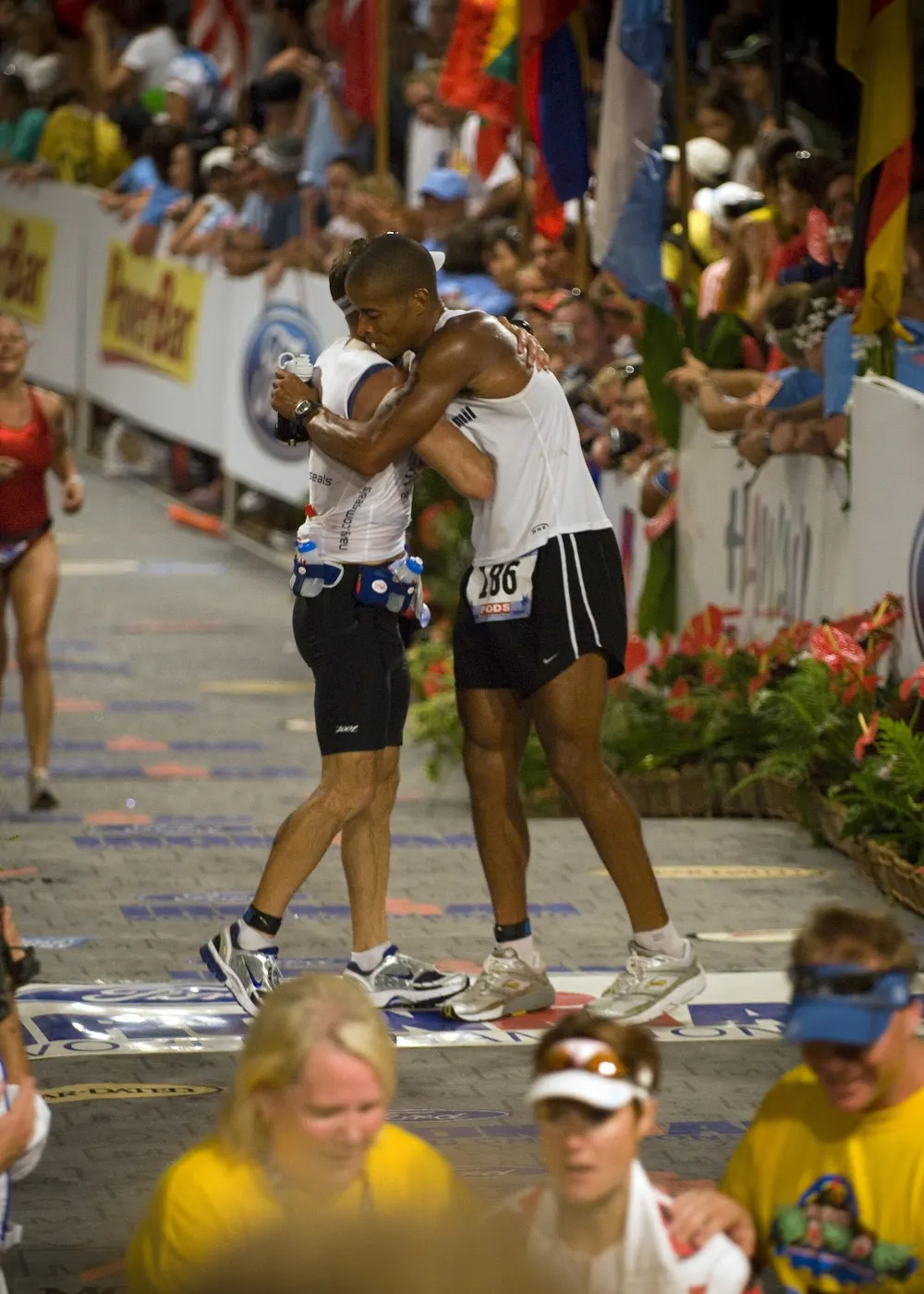
He kept going. Over the next few years, he ran dozens of ultramarathons and triathlons, often in a shirt or cap that promoted the foundation. He raced the Ironman World Championship in Kona, Hawaii. Photos from the finish show him embracing a supporter at the line, worn out and emotional. He finished third at Badwater in 2007. He ran races of 100 miles, 150 miles, and more. With each race, more people heard his story, and more money went to the families.
He also found out that his body was not built the way he thought. He was constantly tired and short of breath. Around 2009, doctors found that he had a hole in his heart, a condition called an atrial septal defect. He had been running ultramarathons and going through SEAL training with it. He had heart surgery to fix it. It took more than one procedure.
4,030 pull-ups
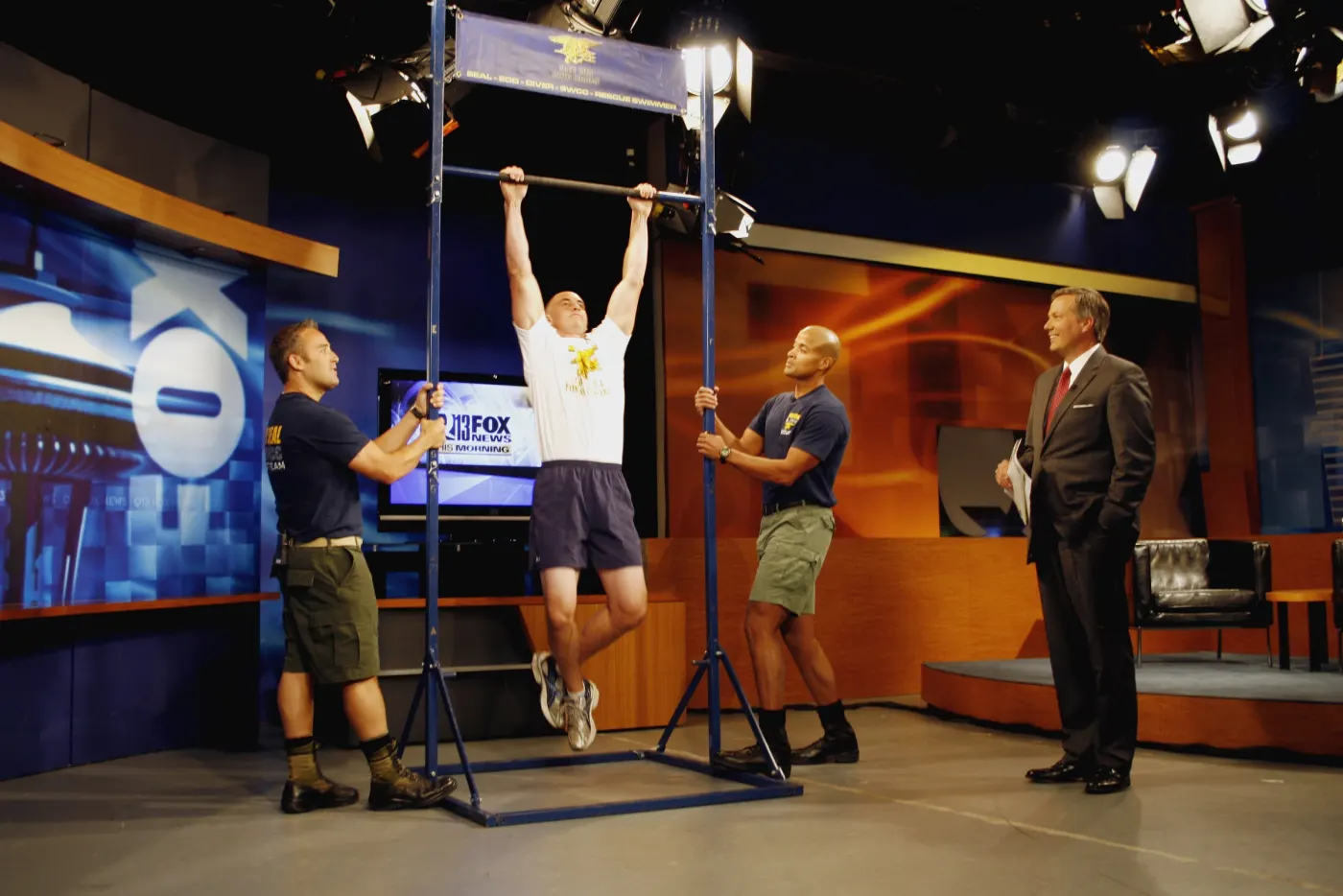
After his heart recovered, Goggins set his sights on a new kind of pain: the world record for most pull-ups in 24 hours.
He trained for months, doing tens of thousands of pull-ups. In his telling, he did about 67,000 pull-ups in training over nine months.
His first attempt, in September 2012, was shown on national television. He reached about 2,500 before his muscles gave out. He failed in front of millions of people.
Two months later, he tried again. His hands tore open and his arms swelled. He failed again.
On 19 January 2013, he tried a third time. He did his pull-ups in sets of five, with official witnesses counting every one. His palms were so torn that he says it looked like a burn. After 17 hours, he reached 4,030 pull-ups, a new record at the time.
He has said that when he finished, he did not feel happy. He felt relieved that he did not have to do any more pull-ups.
Others have since beaten his mark. But the record did what he wanted it to do. It became another cookie in the jar, and another story he could use to raise money and push people to test themselves.
Living with a SEAL
Around this time, a businessman named Jesse Itzler saw Goggins run a 24-hour race by himself. Itzler was amazed and a bit confused. He asked Goggins to come live with his family for a month and train him.
Goggins agreed. The first day, he asked Itzler how many pull-ups he could do. Itzler managed about eight. Goggins told him to rest, then do more. By the end of the session, Itzler had done 100.
That month, Goggins had Itzler running in freezing weather, doing push-ups at odd hours, and learning to push past what he thought were his limits. Itzler later wrote a bestselling book about it, called Living with a SEAL. It introduced Goggins to a big new audience.
How he works
Over the years, Goggins built a set of rules for his mind. He shares them the same way he talks: loud, blunt, and full of swearing.
The accountability mirror means facing the truth about yourself every day.
The cookie jar means remembering past victories when things get hard.
The 40 percent rule is his idea that when your mind says you are finished, you have really only used about 40 percent of what you have.
Callusing the mind means doing hard things on purpose, again and again, so that your mind gets tough the way hands get calluses from work.
He also talks about the "one second" when you want to quit. In that second, he says, your mind picks the easy path. He trains himself to ask, "How can I get through this?" instead of "Why am I here?"
His daily routine is famous among his fans. He wakes up very early, often around 4 in the morning. He runs, rides, and lifts. He spends hours stretching, because his muscles and joints became so tight from years of abuse that simple movement hurt. He keeps a detailed log of his workouts.
He has said many times that he is not naturally gifted. He says his talent is his willingness to suffer.
One of his most famous lines is "Who's gonna carry the boats?" It comes from BUD/S, where trainees carry boats together, and no one gets to hide. For Goggins, it means that when things get hard, someone has to step up and do the work. He wants that person to be you.
He also talks about being "uncommon among uncommon." In his view, getting into an elite group is only the start. Once you are there, you should keep pushing harder than everyone around you, even when no one is watching.
He likes to plan for the worst. Before big races, he pictures what could go wrong, from bad weather to injuries, and decides ahead of time how he will handle it. That way, when the moment comes, he has already made the decision.
Leaving the Navy, fighting fires
In 2015, after about 20 years in the military, Goggins retired from the Navy. He had reached the rank of Chief Petty Officer.
He did not slow down. He has said that near the end of his Navy career, he spent time traveling to schools and speaking to students as part of Navy outreach, telling them about his childhood and about how he changed. He found that his story made teenagers sit up and listen. That experience helped prepare him for the speaking and writing that came next.
After the Navy, according to his interviews, he trained as a wildland firefighter and spent seasons fighting forest fires in Montana. He also trained as an emergency medical technician. He kept racing ultramarathons, including the Moab 240, a race of about 240 miles through the Utah desert and mountains. In one of those races, he says, he had his knees drained of fluid just days before the start and finished in about 62 hours.
Can't Hurt Me
In December 2018, Goggins published his first book, Can't Hurt Me, written with the journalist Adam Skolnick. He self-published it instead of working with a big publisher, so he could tell the story exactly his way.
The book mixed his life story with challenges for the reader at the end of each chapter. It told the truth about his father, his school years, his weight, his failures, and his training. It was angry, funny, and honest.
Each chapter ended with a challenge. Readers were told to write their own hard truths on sticky notes, to list the hardest things they had survived, and to pick a goal that scared them. The book was not asking people to become SEALs. It was asking them to stop making excuses in their own lives.
The audiobook became a phenomenon. Instead of just reading it, Goggins and Skolnick recorded it like a podcast, stopping after each chapter to talk about what had happened. Many listeners said it felt like having Goggins in the car with them.
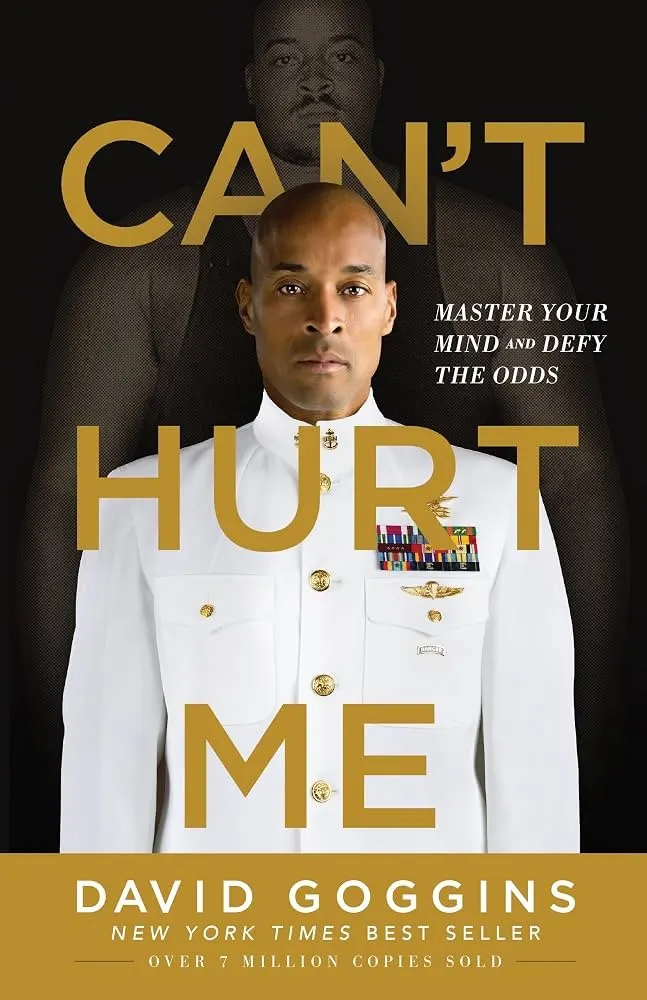
Can't Hurt Me became a huge bestseller. It stayed on bestseller lists for years and sold millions of copies around the world. Goggins began appearing on popular podcasts, including multiple long interviews with Joe Rogan. Short clips of him shouting "Stay hard!" spread across social media.
His first appearance on The Joe Rogan Experience, in early 2018, became one of the most talked-about episodes of the show that year. Millions of people heard his story in his own voice for the first time. For many listeners, the words that stuck were simple. Stop feeling sorry for yourself. Stop blaming others. Go do the work.
Never Finished
In December 2022, he released a second book, Never Finished. He said Can't Hurt Me was like a bachelor's degree, the basics. Never Finished was meant to go deeper.
He wrote about his mental health, his injuries, his fear of failure, and the dark places he goes when he trains. He talked about the difference between hope and belief. Hope, he said, is wishing someone will pull you out of the cold water. Belief is knowing you can get through because you have done hard things before.
He also called himself a philosopher. He said people only see the short, loud clips, but his real life is quiet, lonely, and full of hard thinking.
Hard questions
Goggins's story is powerful, and it is mostly told by him. Some critics have said parts of it are exaggerated, or that his message of pushing through pain can be dangerous, especially for people with injuries or mental health struggles. Doctors often warn that ignoring pain can lead to lasting damage. Goggins has answered that he is sharing what worked for him, not a rule for everyone.
His personal life has drawn attention too. In 2025, his adult daughter's claims that he had been absent from her life spread online. Goggins publicly disputed those claims and described a different account. The disagreement has not been settled in any public forum.
He has been married more than once. In recent years he has often appeared with his wife, Kish, who also runs and helps manage his work.
Back on the trail at 50
For about five years, injuries kept Goggins away from ultra races. He had problems with his knees, his tendons, and his whole body after decades of punishment.
In August 2025, at age 50, he came back. He entered the Bigfoot 200, a mountain race of about 200 miles in Washington State. His knee gave him trouble early. He had to shuffle. Other runners and volunteers cheered him on at aid stations.
He finished in about 66 hours.
Official results listed his time at 66 hours, 4 minutes, and 17 seconds. He was not near the front of the race. Placing was not the point. For a 50-year-old with a bad knee, finishing was the victory.
That fall, he took on the Moab 240 again. Then, in November 2025, he started a 200-mile race across Florida but stopped early. According to reports, his wife said he had started it with a torn hamstring.
World impact
Goggins never built a company with factories or thousands of workers. What he built is an idea: that people can change their lives by doing hard things on purpose and refusing to lie to themselves.
His books and videos have reached millions of people. Soldiers, athletes, students, and office workers post about running at 4 in the morning because of him. Coaches play his clips in locker rooms. People who once felt stuck write that his story made them get off the couch.
His fundraising helped draw attention and money to the Special Operations Warrior Foundation and the families of fallen troops.
He also helped change how people talk about mental toughness. Before, it often sounded like something you were born with. Goggins talks about it like a muscle that anyone can build.
Not everyone agrees with his methods. But few people have had his reach.
His message has also become part of fitness culture. Early morning runners, military hopefuls, and people recovering from addiction share his quotes as reminders to keep going. The phrase "Stay hard" appears on gym walls and workout playlists. For some fans, following Goggins is less about running ultras and more about facing one small hard thing each day.
2026 snapshot
In 2026, David Goggins is 51 years old. He still posts workout videos and short, fierce speeches that are viewed by millions. Can't Hurt Me and Never Finished still sell strongly. He has spoken for years about a third book, but no release date has been officially announced.
He is still running, still stretching for hours, and still testing his body in races that most people half his age would not try.
Closing
David Goggins grew up afraid. Afraid of his father, afraid of water, afraid of failing, and afraid of being seen for who he really was. He spent years hiding behind a costume.
Then he looked in a mirror and decided to stop lying. He lost more than 100 pounds, went through Hell Week three times, ran 101 miles on no training, and did 4,030 pull-ups with torn hands. Not because he loved pain, but because he wanted to find out what he was made of.
His answer to the world is simple and loud. You are capable of more than you think. And the only way to find out is to go do the thing you are most afraid of.
Watch alongside this story
Short cuts from interviews, keynotes and launches. Each plays only the moment that matters.