The 10X Man: Grant Cardone's Loud Road to Real Estate
He lost his father at ten. He nearly lost his life to drugs by twenty-five. He now runs one of the loudest real estate firms in America.
On a rainy night in Lake Charles, Louisiana, a skinny twenty-three-year-old stood in the doorway of a tiny duplex apartment. He rented one half of the building. A friend named Danny had just come by. When Grant walked Danny back to the door, a very large man was waiting outside with a pistol, and the man pushed the gun toward Grant's face.
Grant was holding a dinner plate. Without thinking, he swung it. The plate was the unbreakable kind, the kind sold in stores with a promise that it will never crack. It cracked across the man's face. Then the man turned the gun around and beat Grant with it until blood covered the walls and even the ceiling of the room.
His girlfriend drove him to the hospital. Doctors closed the wounds on his head and face with about seventy stitches. He stayed three days. Lying in that bed, he swore he was finished with drugs forever. By his own telling, he was using again about fifteen minutes later.
That young man was Grant Cardone. Today he is one of the most recognized business personalities in the United States. His company, Cardone Capital, says it controls more than 14,800 apartment units worth more than five billion dollars. He has written bestselling books about sales, filled arenas with his 10X Growth Conference, starred in a reality show about starting over with one hundred dollars, and mixed apartment buildings with Bitcoin in a way few landlords had tried.
He is also one of the most argued-about figures in American business. Millions of people follow him for his fire. Critics say his promises are too big. Some investors have taken him to court, and those cases are not finished. To understand how a beaten, broke kid from Louisiana ended up at the center of all of that, you have to go back to a house on the lake that his father never got to enjoy.

Two boys and one imaginary friend
Grant Timothy Cardone was born on March 21, 1958, in Lake Charles, a small industrial city in southwest Louisiana near the Texas border. He was one of five children of Curtis Louis Cardone and Concetta Neil Cardone. And he was not alone even on the day he arrived. He has an identical twin brother, Gary.
The twins were so close that, as small boys, they shared the same imaginary friend. They called him Frankie. They lived on Tenth Street, and they did almost everything together. Their parents did not have to entertain them. The boys invented their own games and played them from morning until night.
Their father was the kind of man who made a small town feel like family. He owned a grocery store, and he had also trained as a stockbroker. The twins still remember walking into Gibson's, the big sporting goods store in Lake Charles, with their dad when they were five or six. He would stop the little boys at the door and talk to them before they went in, as if the trip were a mission. To the twins, he was a giant.
He had a dream, too. About two and a half years before he died, he bought a house on a lake. It was the house he had worked for, the one that meant he had made it. The whole family knew what it meant to him.

The year everything changed
When Grant was about ten years old, his father died. Gary has said he thinks they may have been nine. Either way, the boys were still in grade school, and the center of their world was suddenly gone.
Their mother was left to raise five children alone. She did it with fierce discipline. Years later, the twins agreed they never once remembered going hungry. She put three meals on the table every day. But she also made hard choices. She sold the lake house, the house that had been their father's dream. The family moved to a smaller brick home across the street from a school the boys nicknamed the prison school.
Grant was angry, and he did not know where to put the anger. He was angry that his father never came back. He was angry that the uncles did not come to help. He was angry that the lake house was gone. He was even angry at the little brick house, which he later said he resented. Gary was angry too. The two brothers, who had shared everything, began to fight. They were not small fights. In one of them, Gary said, somebody ended up with a busted spleen. In another, Grant threw his brother so hard that Gary still carries the scar on his leg.
There were other wounds. One of the twins needed major surgery on his arm as a small boy, and it slowed his growth for a while. Junior high school brought bullies. The twins later said the loss of a father and the loss of that dream house left them with a kind of anger they did not understand until they were grown men.
About ten years after their father died, the family was hit again. Grant's older brother Curtis also died.
Baseball, then something darker
Grant loved baseball. He played catcher, and he dreamed of playing the game for a living. A local coach, the father of a friend, took an interest in him and became a kind of mentor while his own father was gone.
But by sixteen, Grant had started using drugs. He did not plan it. Nobody starts out planning to become an addict, he has said. At first it was a way to feel better, or at least to feel nothing. Then it became a habit, and then it became the center of his life. His twin was using too. Every morning Grant promised himself he would not do it that day. By nine o'clock he was doing it.
He finished high school at La Grange High School in Lake Charles in 1976. Somehow, while fighting the addiction, he also earned an accounting degree from McNeese State University, the college in his hometown. He later said it took him about five years to get out.
The drugs cost him more than time. He chose them over baseball, and the dream of a pro career faded away. He lost jobs. He lost the trust of the people who loved him. He looked at the jobs he had lost and the man he had become, and, as he put it, he hated himself every single day from about eighteen to twenty-three. He stopped blaming his father for dying. He just blamed himself.
A plate, a pistol, and seventy stitches
The night in the duplex should have been the end of it. The gun, the blood on the walls, the three days in the hospital, and the seventy stitches all pointed to one message. But addiction does not listen to messages.
Grant went home to his mother's house with his face stitched shut. He knocked on the back door of the little brick house. His mother opened it and did not recognize him at first. Where is my son, she asked. She laid him on the couch. The hospital did not want him to sleep because of his head injury, so he went back for more care. And the drugs kept coming.
He kept using for about two more years. His weight dropped to around 135 pounds, about thirty-five pounds lighter than he would be as a healthy adult. His skin turned a gray, ashy color. He overdosed three times.
Looking back, the twins agree they were lucky to stay out of prison. Grant has said he should have died three times.

The day his mother said no more
The turning point came from the person who had held the family together after their father died. When Grant was about twenty-five, his mother told him he was no longer welcome in her home or in her business. She had had enough.
He could tell it was hard for her. It may have been the hardest thing she ever did. It also worked. In his main telling of the story, within about twenty-four hours he checked himself into a treatment center. In another interview he said it was about two weeks later. Either way, he walked in on his own.
He stayed for thirty days. For the first time in his life, the promise to quit actually held. He has said he did not use drugs again for the next seven, eight, nine years, and he has described himself as sober ever since.
While he was inside, something happened back home that he has never forgotten. According to Grant, three young men he had been hanging around with were killed while he was in treatment. If he had not gone in, he believes, he might have been one of them.
Settle for a clean day
Before Grant left the treatment center, a counselor pulled him aside. In treatment, Grant had told the staff everything. He had confessed his secrets and his mistakes. He had also shared his dreams. He wanted to write books. He wanted to speak to big audiences. He wanted to help people by telling them what drugs had done to him. And he wanted to be rich, rich enough to take care of a family the way his father had.
The counselor did not like what he heard. He told Grant he would probably see him back there again, if Grant did not die first. Then he gave him some advice. Forget the books. Forget the speeches. Forget being rich. You are a drug addict, the counselor said, and that is all you will ever be. If the day ends and you have not used drugs, that is a good day for you.
Grant has told this story many times, and it always lands on the same line. He was twenty-five years old. He was not going to spend the rest of his life counting clean days and calling that a win. He was going to be somebody.
He knew the counselor was right about one thing. Going home was dangerous. Every friend he had used drugs. His girlfriend used drugs. Even the people at his old job used drugs. So he cut them all off. Later he would say that they were never really friends. They were enemies he had mistaken for friends.
Use the addiction
Once he was clean, Grant took an honest look at his life. He noticed a pattern. Every time he had free time, he got into trouble. So he made two rules. First, stay away from the old crowd. Second, keep every hour busy.
Then he asked himself a simple question. What are you good at, Grant? The answer surprised him. He was good at going all the way. Even when he was using drugs, he never did anything halfway. He was an all-in kind of person. What if he pointed that same force at something good?
The number ten kept showing up in his story. His father died when he was ten. He was using drugs about ten times a day. He was trying to quit about ten times a day. So he decided that whatever he did next, he would do ten times more of it than a normal person would. That idea would one day become the title of his most famous book and the name of his whole brand. But in the early 1980s, it was just a young man's private rule for staying alive.
Leaving Lake Charles
Grant believes one of the best things he ever did was leave home. He moved from Lake Charles to Houston, where two of his sisters lived. His brother Gary was there too. Grant later admitted it was partly a comfort move, not a bold adventure. But it was a start.
He has built a whole theory around this. If he had stayed in Lake Charles, he has said, he would have become a very small human being. He does not look down on people who stay in their hometowns. He simply felt he needed to see more of the world, and he noticed that many of the people he read about in history books had left home, traveled, and pushed past their comfort zones.

Seven years on a car lot
The only job Grant could really hold was selling cars. It was not glamorous. It was not what he had dreamed about in treatment. But he decided to stop looking for other options and get very good at the one thing in front of him.
He sold cars for about seven years in total. At first, he sold the way many salesmen did back then. He called it trickery. The salesman controlled the conversation, held back information, and played mind games with the customer. Grant noticed that it did not work very well. Customers did not trust it, and neither did he.
So he flipped it. He started telling customers everything they wanted to know right away. Price. Monthly payment. Down payment. Interest rate. He gave them so much information that there was nothing left to hide. Decades later, he still calls this his information overload approach, and he still uses it when he sells online.
He also did something unusual for a car salesman in the 1980s. He recorded himself. He taped his conversations with customers and listened to them again and again. He studied every step of the sales cycle, from the greeting on the lot to the handshake at the end. He became obsessed with why people said yes and why they walked away.
That obsession became a product. Grant realized that what he had learned on the lot could be taught to other salespeople. He began training car dealers and their sales teams.
A sign from Salt Lake City
The training business was hard at first. For about three years, Grant traveled from dealership to dealership, calling on one owner after another. He has said he was making about thirty thousand dollars a year.
Then came a low point in Houston. He had just run an event in another city that lost money, and he was ready to quit. He sat down and prayed out loud. God, he said, if you are real, show me a sign.
He got into his car, a Toyota Camry. In front of him was a car with a license plate that said Salt Lake City. That's the sign, he decided. On Monday, he flew to Salt Lake City.
Something changed on that trip. His pitch changed. His offer changed. He sold three or four hundred tickets to a sales training event for car dealers. In one version of the story, the event brought in about $120,000 from $300 tickets, and it sold out in thirteen days. He has said this happened in 1988, when he was thirty. It was the start of what he still does today, which is teaching large rooms of people how to sell.
His message to the car business was simple and, at the time, new. Stop playing games. Meet the customer on the lot and ask what information they need. Be open about the numbers. A lot of dealers had never heard anyone say that.
A dollar he could not stop counting
The sales training business grew into a company that would be called Cardone Training Technologies. Over time, it sold seminars, recorded programs, and later online video training to car dealers and to companies in many other industries. Grant moved from Houston to La Jolla, California, near San Diego, where he lived for about twelve years.
He was earning real money now, and he became curious about what to do with it. His first real estate investment was a single-family house in Houston that he rented out. It performed poorly. Grant came away with a lesson he still preaches. One house, he decided, was too small a bet. When a single-family tenant leaves, your income drops to zero.
So he went bigger. His first apartment deal was a thirty-eight-unit building in San Diego. He paid about $1.9 million and put down about $350,000, which felt like a fortune to him. Different sources give different years for the purchase, some saying the late 1980s and others the mid-1990s. What matters more is what he learned. When one tenant in a thirty-eight-unit building leaves, thirty-seven are still paying rent. Next came buildings with forty-eight units and then ninety-two.
He kept buying. Years later, he said he had bought about 2,200 units at a time when many people knew him only as a sales trainer. Apartments had become his second career, and eventually they would become his main one.
Learning to be seen
For many years, Grant was a successful but mostly unknown businessman. He was well known in the car business and almost invisible outside it.
In 2004, on the Fourth of July, he married Elena Lyons, an actress. The couple would have two daughters. Elena would become a partner in much of his business, not just his life. Grant has said that later, when the family moved across the country, the move made the marriage stronger because they had to lean on each other in a new place.
Grant also began to write. In 2010, his book If You're Not First, You're Last became a New York Times bestseller. It argued that in a tough economy, playing it safe was the most dangerous move of all. A year later came The 10X Rule, which turned his old recovery rule into a business philosophy. Set targets ten times bigger than you think you need. Then take ten times more action than you think it will take. Other books followed, including Sell or Be Sold and Be Obsessed or Be Average.
The books were only part of it. Grant understood something that many older business people missed. The internet was turning ordinary people into media companies. He started making videos. He posted constantly. He answered comments. He went on television whenever he was asked, and he became a regular voice on business shows. He did not whisper. He shouted, laughed, argued, and bragged, and people could not stop watching.

The biggest room in the building
In the second half of the 2010s, Grant moved his family from California to Miami, Florida. He wanted a bigger stage, and he built one.
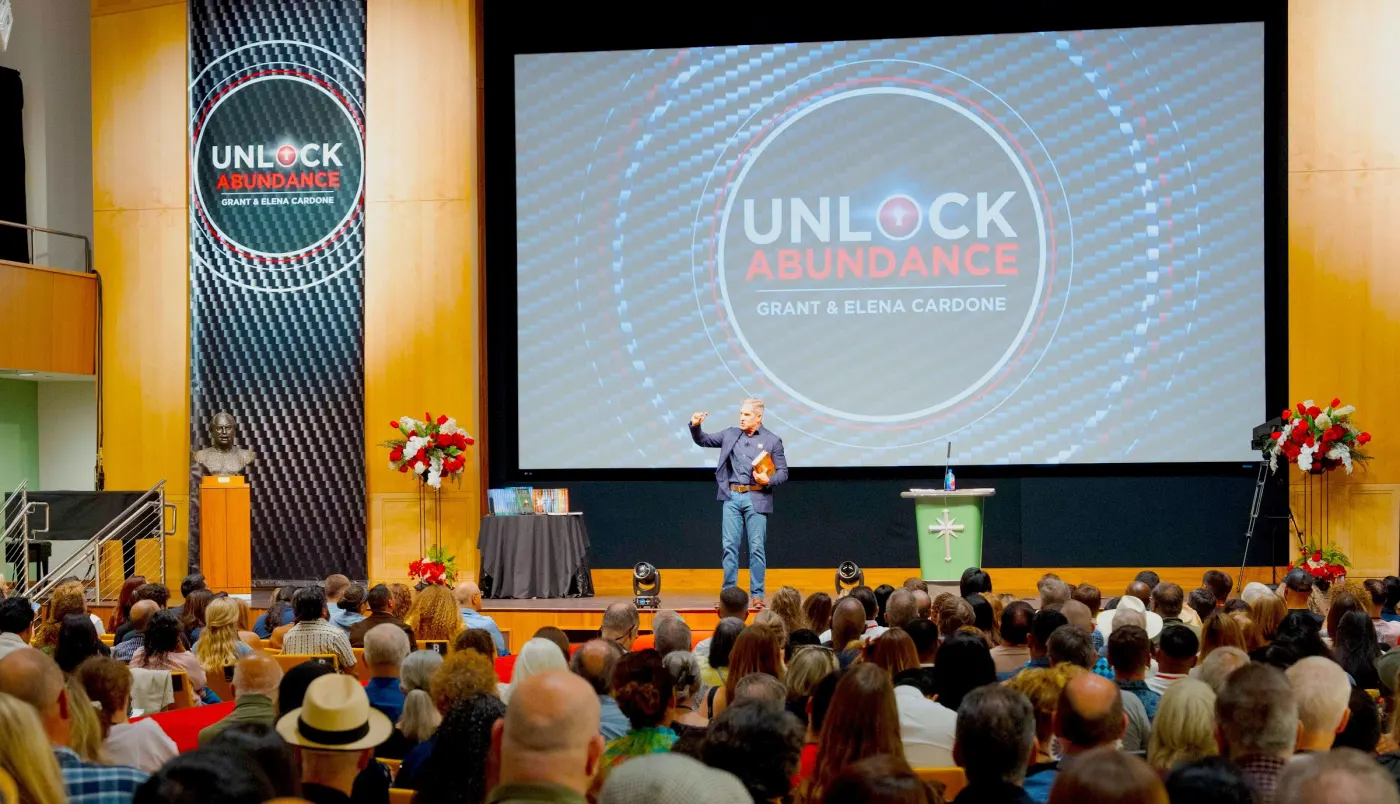
In March 2017, he held the first 10X Growth Conference in Miami. About 2,200 people came to hear him and other speakers talk about business, money, and ambition. The next year, in Las Vegas, the crowd grew to more than 9,000. In 2019, he rented Marlins Park, the Miami baseball stadium, and his team said about 35,000 people came. The boy who once dreamed of playing baseball for a living had filled a major league ballpark with people who came to hear him talk.
The conferences were loud on purpose. Music thumped. Lights flashed. Grant walked the stage like a coach at halftime, telling people that average was a failing formula and that they should stop playing small. Big names shared the stage over the years. In 2022, Donald Trump headlined one of the events, a sign of how openly political Grant and Elena had become.
He sold his programs at these events the same way he had sold cars. There was no big secret reveal at the end. Visitors could see a plain sheet of paper with the packages and prices printed on it, like a menu at a restaurant. Some packages cost tens of thousands of dollars. Grant has said he would rather show the price up front than make people sit through hours of speeches before learning what something costs.

One hundred dollars in Pueblo
In 2020, Grant agreed to a challenge that tested whether his methods worked without his money or his fame. The Discovery show Undercover Billionaire dropped him into Pueblo, Colorado, a working-class city he did not know. He had one hundred dollars, no contacts, and ninety days to build a business worth a million dollars.
He used a fake name, Louis Curtis. It was his father's name, Curtis Louis, turned around.
In Pueblo, he teamed up with a local entrepreneur named Matt Smith, who owned a mattress store called Snooze. Grant first proved himself by running a marketing push for Snooze. He has said a five-thousand-dollar campaign brought back about fifteen thousand dollars. That won him a ten-thousand-dollar advance. With that money and Matt's help, they launched a new company called Wake Up Pueblo.
The COVID-19 pandemic interrupted filming, and the team had fewer working days than planned. Still, at the end of the season, the business was valued at about $5.5 million. Critics pointed out that valuations on reality television are easy to inflate and hard to check. Grant's fans saw it as proof that his system could work from scratch.
Selling apartments on Instagram
Grant's biggest business move of the social media era was not a book or a conference. It was a new way to sell apartment buildings.
For decades, large apartment deals were mostly open to the wealthy. Grant built Cardone Capital to raise money from crowds of everyday investors. Using a federal rule known as Regulation A, his funds could sell shares to ordinary people, sometimes for relatively small amounts. Grant promoted the funds the way he promoted everything else, on Instagram, YouTube, and his own shows.
His message was bold. He told followers that their own homes were a liability, not an asset. Rent, he said, and put your money into income-producing apartments instead. He talked about big projected returns, and he talked about them loudly.
The money came in. Cardone Capital bought large apartment communities across Florida and other Sun Belt states. In 2021, it paid about $744 million for four properties in Fort Lauderdale, Sunrise, and Weston. In 2024, it spent about $200 million on two more projects in Fort Lauderdale and Plantation. The company, based in Aventura, Florida, now says it has thousands of investors in its funds.

How he works
People who have worked with Grant describe a man who is almost never still. He learned in recovery that free time was dangerous for him, and he still fills his days to the edge. He posts, films, calls, sells, and argues from morning until night. He treats attention as a resource, the way an oil company treats oil. Obscurity, he likes to say, is a bigger problem than bad press.
His style comes straight from the car lot. He believes in showing the numbers, repeating the message, and following up more than anyone else would. He writes his goals down every day, often more than once. He thinks most people fail because their goals are too small, not too big.
Some of his views surprise people who only know the loud version of him. In a recent interview he did alongside his twin, Gary, Grant said he actually lacks the stomach for great risk and plays most things conservatively. He also said he has never had the moment many entrepreneurs describe, when they swear they will never work for anyone again. He would gladly work for someone, he said, if they were good people with a big idea. His real shortage, he said, has never been ideas. It has been teams that can actually get things done.
His family is part of the machine. Elena appears in videos, runs her own programs, and helps lead parts of the business. Gary, once his fighting partner, now appears with him in long conversations about their childhood, their mistakes, and their very different views on money.
Critics and courtrooms
The same loud style that won Grant millions of fans has also drawn serious criticism. Financial writers, real estate professionals, and online critics have accused him of hype and of promising more than investors can count on. Grant has pushed back hard, often calling his critics jealous or uninformed.
The most important dispute is a lawsuit filed in 2020 by an investor in two of his funds. The case, known as Pino v. Cardone Capital, quotes Grant's own social media posts, including a video in which he talked about investors walking away with a fifteen percent annualized return. The suit claims that his statements broke federal securities law. A lower court first threw the case out, saying social media posts were not the kind of sales talk the law covers. A federal appeals court disagreed and revived it, ruling that sellers who use social media to reach investors can be responsible for what they say there. In March 2026, a judge certified a class of investors in the two funds. A trial has been set for March 2027. The claims have not been proven, and Grant and his company deny wrongdoing.
Other disputes have been public too. In 2023, former T-Mobile chief executive John Legere insulted Grant during a livestream and called him a fraud. Grant sued him for one hundred million dollars in 2024. The two sides reached a confidential settlement in January 2025. More recently, two people have filed defamation lawsuits against Grant and Cardone Capital, one in late 2025 and one in 2026, claiming he harmed their reputations online. Those cases are pending, and the claims in them are allegations only. A 2022 newspaper investigation also reported that one of his Miami-area apartment complexes had overcharged some tenants in a county workforce housing program. And in 2025, a Las Vegas woman was charged with stealing millions of dollars from several influencers, including about $2.3 million from the Cardones.
Grant has said he likes, in his words, the game of drama and conflict. It is part of what makes him famous. It is also why so many people watch his next move with a mix of admiration and doubt.
Apartments that buy Bitcoin
In late 2024, Grant tried something new again. He launched a fund that combined an apartment building with Bitcoin. The idea is easy to explain. The fund buys a building and some Bitcoin at the same time. Each month, tenants pay rent. After the bills are paid, part of the extra cash is used to buy more Bitcoin. Over time, he says, the building itself becomes a Bitcoin buying machine.
One of these funds, the 10X Miami River Bitcoin Fund, paired a 346-unit apartment community with about fifteen million dollars in Bitcoin. In June 2025, Cardone Capital announced it had bought about 1,000 Bitcoin, and it kept adding more. At a big Bitcoin conference that year, Grant surprised a crowd of believers by warning them about hype. Some companies, he said, were buying Bitcoin, turning it into paper, and borrowing against the paper. Where is the product, he asked. His product, he said, was a place to live, and people will always need one.
In 2026, the company announced a purchase of about 1,200 more Bitcoin, funded partly with rental income, and raised the Bitcoin target for a new Fort Lauderdale fund from 350 to 900 coins. Critics note that the returns he talks about are projections, not guarantees.

Fourteen thousand front doors
In August 2026, Cardone Capital paid about $89.8 million for Orchid Run, a 282-unit apartment community in Naples, Florida. The company said the deal pushed its portfolio past 14,800 apartment units and more than $5.4 billion in assets under management. It said it was still hunting for more buildings across the Sun Belt.
Grant also flirted with politics. In 2025, he publicly floated the idea of running for governor of California. He later said he would probably have been one of the top two candidates, but that his family was not excited, the cost was huge, and the political climate did not suit him. He stayed in business.
At sixty-eight, he is still posting daily, still selling, still filling rooms, and still fighting in public. He splits his time between Golden Beach, Florida, and Malibu, California.
What he changed
Grant Cardone did not invent sales training, apartment investing, or social media. What he did was mash all three together and turn the volume all the way up. He showed that a salesman could become a media company, and that a media company could raise billions of dollars for real estate from ordinary people. Many younger real estate influencers now copy his playbook, from the daily videos to the direct pitches.
He also pushed a hard question into the open. When a business leader sells investments to his followers on social media, what rules should apply? The Pino case is helping to answer that, and its answer will matter far beyond one company.
For many people, his most lasting impact is simpler. Every week, someone who is struggling with addiction or failure hears his story about the counselor and the clean day and decides not to settle.
Closing
Grant Cardone's life has been loud from the start, but it began with a silence: the empty place at the table after his father died. For years he tried to fill that hole with anger, fights, and drugs. It nearly killed him.
Then a mother said no more, a counselor said settle, and a twenty-five-year-old said no. He took the all-the-way force that had almost destroyed him and aimed it at a car lot, then a seminar room, then a stadium, then fourteen thousand apartment doors.
Whether people see him as a teacher, a showman, or something in between, he has never stopped doing the one thing he promised himself he would do in that treatment center. He decided to be somebody. And he has made sure the whole world can hear him.