
Severin Hacker: The Engineer Behind the Owl
He walked into a stranger's office. He said his name was Severin Hacker. The stranger said, "Stay."

The idea sounded silly, even to the man who had it.
It was the early days of Duolingo, a small language app in Pittsburgh with big dreams and no money coming in. The company needed engineers. But in a city full of big companies and good universities, it was hard to get smart students to join a tiny startup they had never heard of.
Severin Hacker, one of the two founders, had a thought. What if Duolingo showed up at job fairs with a giant costume of its mascot, a green cartoon owl named Duo? No other company would have one. Students would have to stop and look.
He told his girlfriend about it. She was not impressed. He later remembered her saying it was the worst idea he had had in a long time. The company was losing money. It should not spend $2,000 on a costume.
He ignored the advice. He got approval from his co-founder, Luis von Ahn. The costume was made, and it went to job fairs. It worked.
Years later, the same owl costume would star in strange, funny videos on social media, and millions of people would come to know Duo as one of the most famous mascots on the internet. Hacker has called that costume the best return on money of any idea he ever had at Duolingo. And the girlfriend? She became his wife.
It is a small story. But it says a lot about the quiet Swiss engineer who helped build the world's most popular language app. He is not a showman. He is careful, logical, and hungry for data. But now and then, he takes a strange bet, tests it, and lets the results speak.
A small town near Zurich
Severin Hacker was born in 1984 in Switzerland. He grew up in Zug, a small city on a lake in the German-speaking part of the country, not far from Zurich. He went to school there, all the way through.
At home, he spoke Swiss German. At school, he had to learn standard German, which is close but not the same. Then came French, which is one of Switzerland's other national languages. His French, he admits, never became great. Later he learned English.
For someone who would one day help teach languages to hundreds of millions of people, he has been surprisingly honest about his own skills. He has said that he is not very good with languages. He had to work hard at them, like everyone else.
What really caught his attention as a boy was not grammar. It was video games.
Hooked on games
Hacker has said that video games were what first drew him to computers. He did not just want to play them. He wanted to know how they worked. He wanted to build his own. He has described himself as somewhat obsessed.
That curiosity is common in kids who become engineers. You play a game, and then you start to wonder what is going on behind the screen. Why does a character jump this high? How does the game know you won? Who decides what happens next?
Years later, those questions would matter in a way he could not have guessed. Duolingo would become famous for making learning feel like a game, with points, levels, streaks, and a cartoon owl cheering you on. The boy who wanted to know how games worked would help design one of the most popular learning games in history.
ETH Zurich
After school, Hacker studied computer science at ETH Zurich, one of the best technical universities in the world. Albert Einstein studied there. It is known for hard classes and serious students.
He finished his bachelor's degree in 2006. But he had a dream that went beyond Switzerland. For a long time, he had wanted to study in the United States.
There was a problem. ETH did not have an exchange program with the American university he wanted most. But a sister university in Switzerland did. He managed to get himself into that program and won a spot at Carnegie Mellon University in Pittsburgh, Pennsylvania.
Carnegie Mellon is famous for computer science. For a young Swiss student who loved computers, it was a big step. He packed his bags for a city he did not know, planning to stay for an exchange and then go home.
He did not go home.
The list of names
Before he left Zurich, Hacker asked his professors for advice. Who should he meet at Carnegie Mellon? They gave him names. He wrote a list.
Near the top was a young professor named Luis von Ahn.
Von Ahn was already a star. He grew up in Guatemala and came to the United States for college. At Carnegie Mellon, he helped invent CAPTCHA, the squiggly letters websites use to check that you are a human and not a robot. Then he created reCAPTCHA, which used those same puzzles to help turn old printed books into digital text. He sold reCAPTCHA to Google in 2009. He had also sold an earlier project to Google. Hacker says von Ahn was the youngest computer science professor at Carnegie Mellon at the time.
One day, Hacker simply walked into von Ahn's office.
"Hi, I'm Severin Hacker," he said.
Von Ahn looked at him. Who was this? Was that a joke? Hacker had to repeat himself. Yes, Severin. Yes, Hacker. That was his real name. Like severing something. Like a computer hacker.
Von Ahn still tells that story. The name stuck with him. And the student who owned it had a project idea to pitch.

A PhD by accident
The project Hacker pitched was not Duolingo. It was something else, somewhat related. But von Ahn liked the student. He told Hacker he should stay at Carnegie Mellon and become his PhD student.
Hacker had never planned to get a PhD. He did not want to become a professor. He has joked that he has a PhD "by accident." Today he tells young founders that unless they want to become scientists, they probably do not need one. Then he adds, with a smile, that in his case it worked out. Without the PhD, there would be no Duolingo.
He applied to the program and got in. He spent time as a research intern at Microsoft. He studied how humans and computers can work together on huge tasks, a field called human computation. It was von Ahn's specialty. reCAPTCHA was a perfect example: millions of people solving tiny puzzles, and all that small effort adding up to digitized books.
About two years into the PhD, the two of them started working on a new question.
The big question
The internet was full of information, but most of it was in English. Billions of people could not read it. Computer translation existed, but it was not very good at the time. Von Ahn and Hacker felt that people who spoke two languages could do a much better job than software.
But how do you get millions of people to translate the web for free?
Their answer was clever. Millions of people wanted to learn a new language. Most of them could not afford expensive classes or software. What if they could learn for free, and while they practiced, they translated real sentences from real websites? Students would learn. The web would get translated. Everyone would win.
Hacker later wrote his PhD thesis about this very system. It was called "Duolingo: Learning a Language While Translating the Web." In it, he described how students could learn as well as with traditional methods while producing large amounts of good translation.
They also picked languages for personal reasons. Both founders had to learn English as a second language. Von Ahn grew up speaking Spanish. Hacker grew up speaking Swiss German. They figured they could at least teach English, Spanish, and German. And language was one of the few subjects people study outside of school, on their own time, which meant they would not have to sell to schools.
Duolingo has since been described as a happy mistake. The translation idea faded. The learning part took over the world.
Too big for the university
The project won a research grant from the National Science Foundation. That paid for students to work on it. Then it grew. Soon there were about eight people working on it inside the university.
One day, the university told them it had a problem. Carnegie Mellon is a nonprofit. It cannot have a business running inside it. If it did, it could lose its nonprofit status.
"They kicked us out," Hacker remembers.
It was not a disaster. It was a push. If the project was too big for the university, maybe it was big enough to be a company. In August 2011, Hacker and von Ahn officially founded Duolingo. Hacker became chief technology officer, the person in charge of the technology. Von Ahn became chief executive.
For Hacker, it was his first full-time job. He has never had another.
Sand Hill Road
The new company needed money. Hacker has said the first round was hard to raise. What helped was von Ahn's record. Investors knew he had already sold two companies to Google.
The founders flew to California and made the famous tour of Sand Hill Road in Silicon Valley, where many of the richest venture capital firms have their offices. The investors liked Duolingo. Many wanted to invest.
But almost every meeting ended the same way. When are you moving here?
Hacker and von Ahn said they were not moving. They wanted to stay in Pittsburgh, near Carnegie Mellon and its talented students. Hacker says he could see the investors' faces change.
In the end, they raised money from an East Coast firm, Union Square Ventures in New York, which did not mind that they were in Pittsburgh. The team took an office close to the university. Nearly everyone who worked there was a Carnegie Mellon student or connected to the school.
Hacker enjoys one part of the story. Some of the investors who turned them down came back later and invested in later rounds, at much higher prices.
Launch day
Duolingo opened to its first users in a private test in late 2011. Hundreds of thousands of people reportedly signed up to wait for an invitation. In June 2012, the website opened to everyone.
Hacker was writing much of the code himself in those days. He built the systems that served lessons, graded answers, and tracked what each learner knew.
Later in 2012, Duolingo launched an iPhone app. A year after that, Apple named it the iPhone App of the Year for 2013. For a tiny company from Pittsburgh, it was a huge moment. Suddenly, people everywhere were practicing Spanish on the bus and French in the waiting room.
A 2012 study, paid for by Duolingo and carried out by outside researchers, suggested that about 34 hours on Duolingo taught as much as a college semester of Spanish. It was only one study, and critics pointed out its limits. But it gave the young company a strong message to share.
Motivation is the hardest part
Early on, Hacker and von Ahn asked a simple question. What is the hardest part of learning a language?
It is not the grammar. It is not the vocabulary. It is sticking with it. Most people who try to learn a language give up.
Duolingo is not a school. Nobody has to use it. There is no teacher to call your parents and no grade on a report card. So from the start, the founders decided that Duolingo had to be fun enough that people wanted to come back.
That is where the video game lover came in. Duolingo added points, called XP. It added levels, leaderboards, hearts you could lose for mistakes, and, most famously, the streak, a count of how many days in a row you have practiced. Lose a day, and the streak goes back to zero. People hate losing their streak.
Hacker says he knows it works because of his own mother. When he calls her, she sometimes has to hang up. She is on a Duolingo streak, and she does not want to lose it.
Hundreds of experiments at once
The streak did not arrive fully formed. Neither did anything else. Hacker built Duolingo into a machine for testing ideas.
The method is called A/B testing. Half of a group of users sees one version of a feature. The other half sees another. After a few weeks, the team looks at the data and keeps the winner. It is like a science fair experiment, done with millions of people.
Duolingo runs hundreds of these tests at the same time. That means that if two friends open the app on the same day, they might see slightly different versions of it. Hacker has called this system Duolingo's secret sauce. There is no single test that made the app great, he says. It is the combination of all of them, and the tools that let anyone at the company run a test.
He has said Duolingo had a team of about ten people whose whole job was to build those tools. Any engineer or product manager could ask a question, like whether a new button works better than the old one, and get an answer from real data.
Each test is judged on three things, he explains. Does it teach better? Does it keep people coming back? Does it help the business make money? The best ideas help all three.
Sometimes the smallest change surprises everyone. Hacker has said that changing a single word on a subscription page can make a big difference.
Five years with zero dollars
For all its popularity, Duolingo had a big problem. It did not make money.
The founders had promised that learning on Duolingo would be free. The translation plan was supposed to pay the bills. For a while, Duolingo did sell translations, including to CNN. But that business never grew big enough.
"For the first five years, we made no revenue," Hacker has said. "Like, zero dollars."
The company kept going by raising more money from investors, who were excited by the fast-growing number of users. Hacker has said that some investors probably expected Duolingo to be sold to Google one day, like von Ahn's earlier companies. The founders had no such plan. They wanted to build a lasting, independent company.
The question was how to make money without charging for lessons. Hacker and von Ahn believed that if you charge for content, you shut out the people who need it most. They did not want a poor student with a cheap phone to be locked out of learning English, a language that can open doors to better jobs.
The answer turned out to be a model called freemium. All of the lessons stay free. Free users see some ads. People who want more can pay for a subscription, first called Duolingo Plus and later Super, which removes ads and adds extra features. Hacker compares it to Spotify.
It worked. Over time, most of Duolingo's money came from subscriptions. Hacker says that if the company had simply started charging for lessons like everyone else, it might have lost most of its employees, because they had joined for the mission.
The owl nobody inside wanted
Every famous brand has an origin story. Duo's is a little messy.
Von Ahn decided early that Duolingo needed a mascot. Hacker is not sure why. A design agency was hired, but it passed the mascot job to another company. That company came back with two ideas: a cute little robot and an owl. The first owl even had the word "Duo" in its eyes.
Everyone inside Duolingo voted. They picked the robot.
Then someone suggested asking people outside the company. Friends and partners all said the same thing. Go with the owl.
Hacker had one more request. He has joked that he told the designers he did not care about the color, as long as it was not green. The owl, of course, came out green. He says he has to look at it every day.
For years, the founders focused on the product and did not really understand marketing. Then Duolingo hired a chief marketing officer who brought in young people and let them experiment, as long as they stayed away from the product itself. Early videos on TikTok did badly. Then the owl costume, the one Hacker had pushed for, started showing up in the videos, doing strange and funny things. The account exploded.
Hacker admits he still does not fully understand why it works. Neither does von Ahn. But the data says it does.
Two big mistakes
Hacker is open about what went wrong. He says he and von Ahn made two big mistakes.
The first was waiting too long to make money. For years, they treated Duolingo like a research project instead of a business. Back then, investors mostly cared about growth, not profit. Some told them to keep growing and not worry. Eventually the founders decided on their own that it was time. If they wanted to stay independent, they needed a real business.
The second mistake was waiting too long to hire experienced leaders. Duolingo hired the smartest new graduates it could find. Of the first 20 employees, Hacker says, it was everyone's first job except von Ahn's. That included Hacker himself.
It became chaotic. Hacker says he did not know how to manage people. Then Duolingo hired an experienced engineering leader from Google, Natalie Glance. She brought structure. Hacker says he learned a huge amount from her.
It is not a common thing for a co-founder to say. But it fits the way Hacker thinks. Look at the data. Admit what did not work. Fix it.
Learning to lead
Hacker's job changed every single year, he says. At first he wrote code. Then he reviewed other people's code. Then he designed the big systems. Then he reviewed other people's designs. Then his days filled up with hiring and managing. At one point, he said he spent about half his time hiring, from engineers to executives to board members.
He also built a set of personal rules. The one he talks about most is simple: never cut back on sleep.
He noticed during his PhD that many students worked late into the night and wore themselves out. He decided not to be one of them. He says he sleeps eight to nine hours a night and rarely stays at the office past seven in the evening. When asked what keeps him up at night, he has joked that nothing does. He sleeps very well.
Another rule is famous inside Duolingo. He calls it reduce, automate, delegate. For every task, first ask if it needs to be done at all. Many things do not. If it must be done, see if a computer can do it. If a computer cannot, hand it to someone else. Only do the work that you alone can do, or that you do best.
He describes his leadership style as hands-off. He trusts people and gives them room, and then he checks the numbers.
Ringing the bell
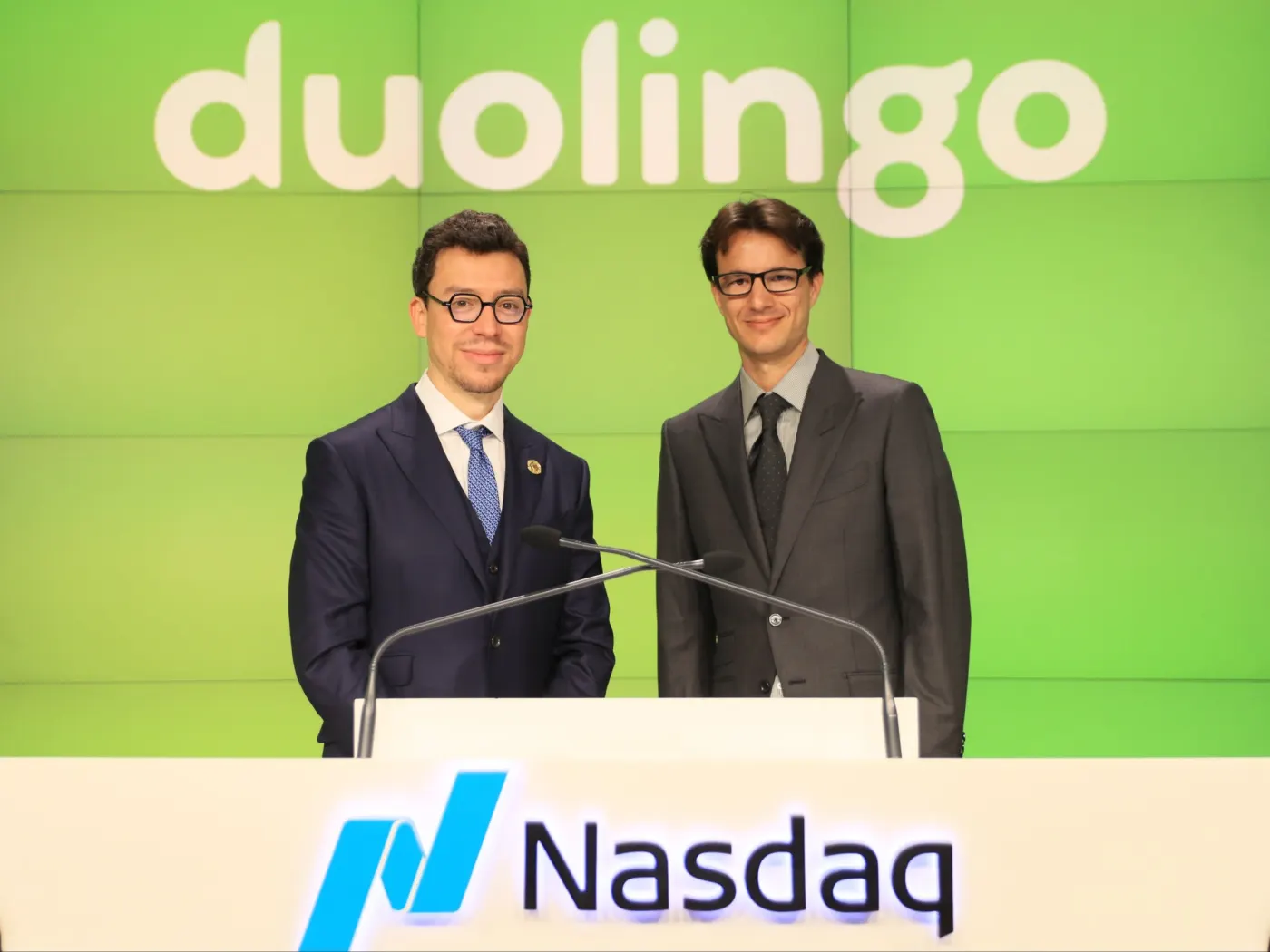
In July 2021, Duolingo became a public company on the Nasdaq stock exchange, under the symbol DUOL. Investors rushed to buy its shares.
For Hacker, it was the moment of his life. He has called ringing the Nasdaq bell the career highlight "by far." He thought about the road that had brought him there. A kid from a small town in Switzerland. A student who came to America on an exchange. A PhD he never planned. A company that was his first and only job. And now millions of people loved the product, and the world's investors were buying in.
Why go public instead of selling to a giant tech company? Hacker's answer is independence. One of Duolingo's guiding principles is to take the long view. If you sell to a bigger company, he says, you end up doing what is best for that company. As a public company, Duolingo could still make its own choices. He has also joked that at some point, Duolingo simply became too expensive to be bought.
More than languages
Hacker has always said Duolingo's mission is bigger than languages. The mission is to provide the best education in the world and make it available to everyone.
In 2016, Duolingo launched the Duolingo English Test, an online exam students can take at home to prove their English. Many universities now accept it for students applying from abroad. It is cheaper and easier to take than older tests.
Then came new subjects. Duolingo launched math and music courses. The company chose them, Hacker explained, because they fit the Duolingo method. You can learn them on a phone, in small steps, mostly by doing, without long lectures.
Chess came next, and it came in an unusual way. Two employees, a product manager and a designer, were passionate about chess. The product manager had some engineering background but had not written much code. Using AI coding tools, he built a working prototype. Hacker admits he and von Ahn were not convinced at first. They did not want Duolingo to become just a game. But the prototype was so fun that it won everyone over. Hacker says the chess course was built in about nine months, the fastest Duolingo had ever created a new course.
The AI bet and the backlash
Hacker has said that when his team first got early access to the powerful AI model GPT-4, it felt like an "iPhone moment." He knew right away it would change everything.
He explains it this way. The best way to learn anything, from chess to golf to French, is with a great personal tutor. Kings and rich families used to hire one for their children. Most people cannot afford that. But AI might be able to teach almost as well as a great tutor, at a tiny fraction of the cost. For a company whose mission is education for everyone, that was a dream.
Duolingo started adding AI features. A paid tier called Duolingo Max let learners ask for explanations and practice conversations with characters. One feature, Video Call with Lily, lets you talk out loud with Lily, a sarcastic cartoon character with purple hair, as if on a video call.
AI also helped the company build courses much faster. Hacker says it took Duolingo about 12 years to build its first 100 or so courses. Then, with AI's help, it built another 148 in about a year.
But AI also brought trouble. In early 2024, Duolingo cut about 10 percent of its contractors. Reports linked the cuts to AI. Hacker later stressed that no full-time employee was laid off, and that some of the change was due to AI and some to other efficiencies.
Then, in April 2025, von Ahn sent a company memo saying Duolingo would be "AI-first." It said the company would gradually stop using contractors for work AI could handle. The memo was shared publicly, and many users were angry. Some said they would quit the app. Critics asked how a company that teaches human languages could lean so hard on machines.
Hacker's answer, looking back, was that the company explained it badly. He said he wished they had focused more on how AI helps learners, and that Duolingo now has to deliver on its promise of a much better AI tutor.
How he works
Hacker is an engineer first. He likes clear questions and clear answers, and he trusts data more than opinions.
At Duolingo, that means experiments. The streak, the leaderboards, the reminders, all of them were tested before they became part of the app. Competitors copy Duolingo's features, he says, but they only copy the tip of the iceberg. The real value is in the thousands of tiny details that were tested and tuned underneath.
He also likes to ignore the competition. Duolingo's first operating principle is "Learners first." Inside the company, he says, people rarely talk about competitors. They talk about users, data, and how to teach better.
He still uses the app. He finished the Spanish course. He went back to improve his French. He has been learning Italian for trips to Italy, though he says it is not very good yet. He speaks, as he likes to put it, about three and a half languages. The one he would most like to learn is Chinese, because it is so different from European languages.
And if he could run an A/B test on anything in the world? He has said government policies. When countries try different rules, it is hard to know which one worked, because every country is different. A clean experiment would give real answers.

Hard questions
Duolingo's success has also raised hard questions.
Some teachers and language experts say that Duolingo is good for building a habit and learning words, but not enough on its own to become fluent. Duolingo points to its own research showing learning gains. Critics note that much of that research is paid for by the company.
Others worry about the same features that made Duolingo a hit. Streaks, reminders, and a guilt-tripping owl can feel less like encouragement and more like pressure. Hacker has spoken openly about trying to "hack the brain" to help people build a healthy habit. Supporters say that is exactly what learners need. Skeptics say an app designed to be hard to put down deserves careful watching.
The AI debate continues too. Duolingo says AI lets it teach more people, better and cheaper. Critics worry about lost work for human translators and course writers, and about the quality of AI-made lessons. Hacker himself has said that AI-made content is still not as good as human-made content, and that humans remain in the loop.
There are money questions as well. In February 2026, Duolingo said it would slow its profit growth to focus on getting more users, including giving more people access to AI conversation practice. Its shares fell more than 23 percent in after-hours trading. The company is betting that more learners today will mean a bigger business tomorrow. Wall Street will be watching.
Beyond the owl
Outside Duolingo, Hacker has invested in other startups, many of them in and around Pittsburgh. They include IAM Robotics, a warehouse robot company, and Gridwise, an app for ride-share drivers. He has also supported new startups in Switzerland, including through Swiss investors trying to grow the country's young company scene.
He has collected honors along the way. In 2014, MIT Technology Review named him one of its top innovators under 35. In 2019, the group One Young World named him its Entrepreneur of the Year. In 2025, Forbes listed him as a billionaire.
He now lives in New York, where Duolingo has a large office, though the company's headquarters remain in Pittsburgh.

2026 snapshot
In 2026, Hacker is in a new chapter.
Duolingo passed $1 billion in yearly revenue for the first time in 2025. By the middle of 2026, it had about 58.7 million daily users, up 23 percent from a year earlier, and about 12.7 million paid subscribers.
TIME magazine named Hacker to its 2026 list of Executives of the Year for tech and data. He told TIME that he thinks Duolingo is "just 1% into this AI wave." His biggest dream is a truly personal AI tutor. "Maybe there's a way to learn 10 times faster if we crack this with AI," he said.
He is also changing his own role. In August 2026, Hacker wrote that he had spent the past few months moving into a more hands-on job, focused on hard technical projects. His new title is builder and member of technical staff. Natalie Glance, the engineering leader he once learned from, now leads Duolingo's engineering as Chief Engineering Officer. Hacker remains a co-founder and a member of the board.
After years of hiring and managing, the boy who wanted to know how video games worked is going back to building.

World impact
Duolingo is now the world's most popular way to learn a language. More than 100 million people use it each month. The company offers hundreds of language courses, from Spanish and English to Hawaiian, Navajo, and High Valyrian from Game of Thrones.
Hacker's part in that story is quieter than von Ahn's, but it is deep. He built the systems that deliver lessons to millions of people every day. He built the experiment machine that turned good guesses into proven features. He helped create a company culture where data wins arguments. And he helped protect the rule that the lessons stay free.
That last choice may be his biggest gift. A student in a poor village, with a cheap phone and a weak connection, can learn English on the same app as a rich executive in New York. The best teacher in the world still costs a fortune. Duolingo is betting that one day, software can come close, and that it will cost almost nothing.
Duolingo has also changed how the tech world thinks about learning. Other education apps now copy its streaks, badges, and cheerful characters. Its owl has become a pop culture icon. Its experiments have shown that a fun app can teach, if it keeps people coming back.

Closing
Severin Hacker still likes to introduce himself the same way he did in that office at Carnegie Mellon. "I'm Severin Hacker." He still explains that yes, it is his real name.
He did not set out to become a billionaire. He did not even set out to get a PhD. He wanted to study in America, build interesting things, and understand how the machines behind the screen really work.
Along the way, he helped build an app used by more language learners than any school in history. He learned to lead by making mistakes and admitting them. He learned that a silly costume can beat a serious plan, if the data says so. And he learned that the hardest part of learning is not the lesson. It is coming back tomorrow.
Today, he is going back to where he started, writing code and solving hard problems. He believes Duolingo has barely begun. If he is right, the next chapter could make a great tutor something everyone can have.
That would make the owl, green or not, worth it.
Watch alongside this story
Short cuts from interviews, keynotes and launches. Each plays only the moment that matters.