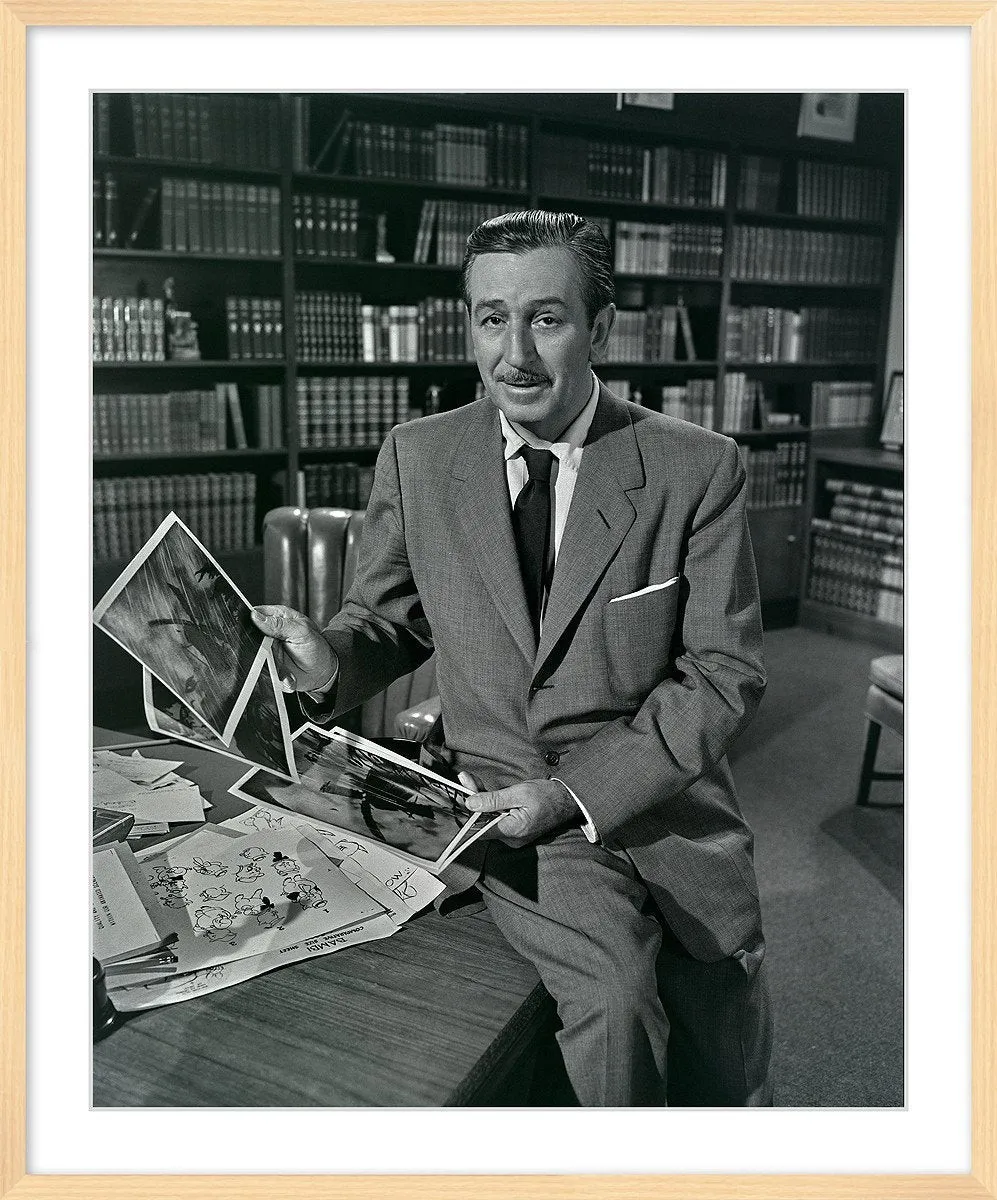
The Man Behind the Mouse
He lost his first studio to bankruptcy. He lost his first star to a contract. Then a mouse on a train changed everything.
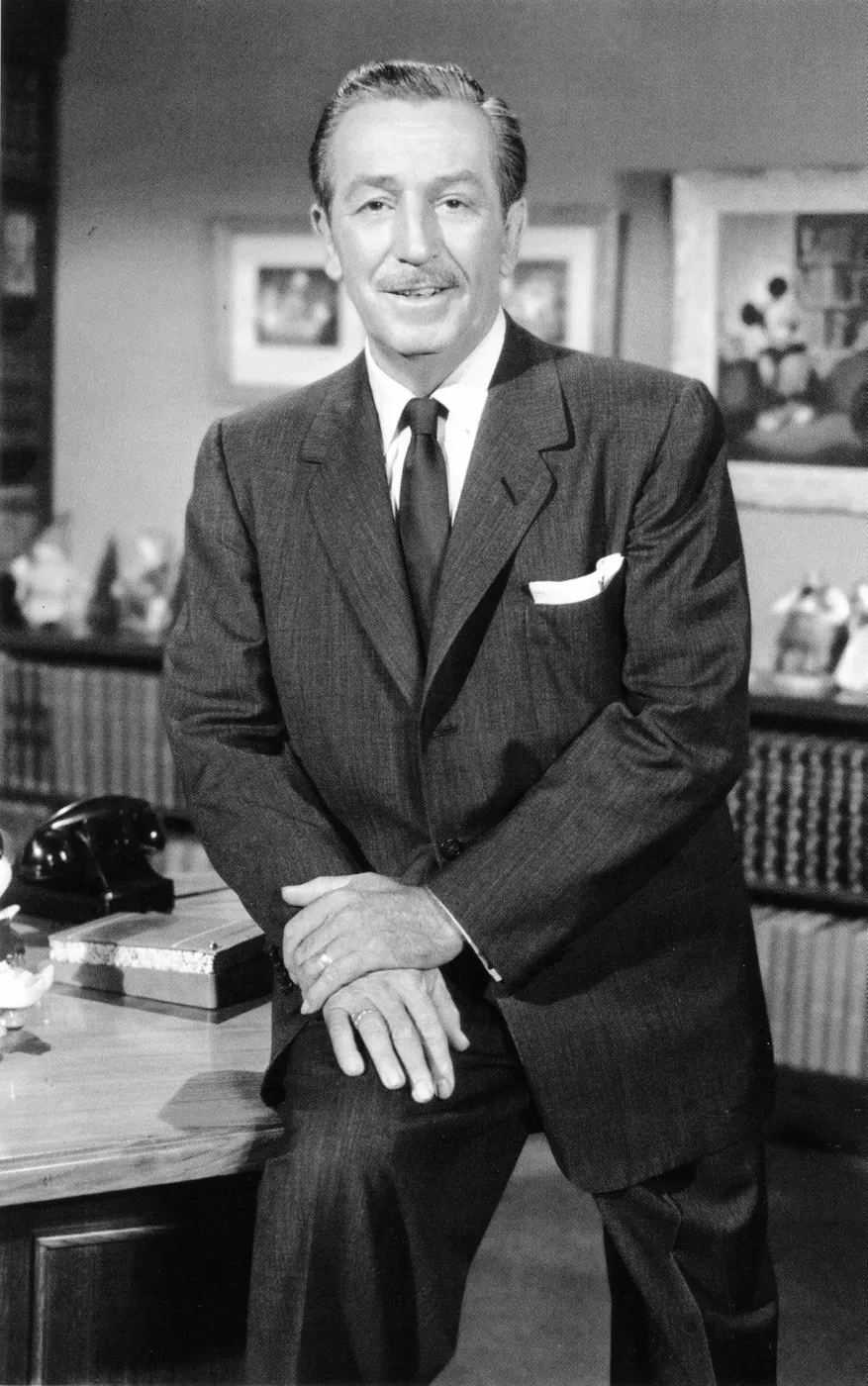
On the night of 18 November 1928, a small crowd sat in the Colony Theatre in New York City. The main feature was a forgettable movie that almost nobody remembers now. Before it came a short cartoon, only about seven minutes long. A mouse in a captain's hat steered a riverboat and whistled a happy tune.
The audience had seen cartoons before. What they had not seen was a cartoon where the whistle, the music, the animals, and the jokes all matched the picture, beat for beat. A goat ate sheet music and turned into a record player. A cow's teeth became a xylophone. People laughed so hard that newspapers wrote about it the next morning.
The cartoon was called Steamboat Willie. The mouse was named Mickey. The man who had bet almost everything on it was a twenty-six-year-old from Missouri named Walt Disney. He was also, quietly, the voice of the mouse.
Walt Disney would go on to win more Academy Awards than any person in history. He would make the first full-length animated feature film in America. He would build Disneyland, invent new kinds of television, and plan a whole city in Florida. But his story starts far from Hollywood, on a small farm, with a boy who loved to draw.
Chicago, Marceline, and a farm he never forgot
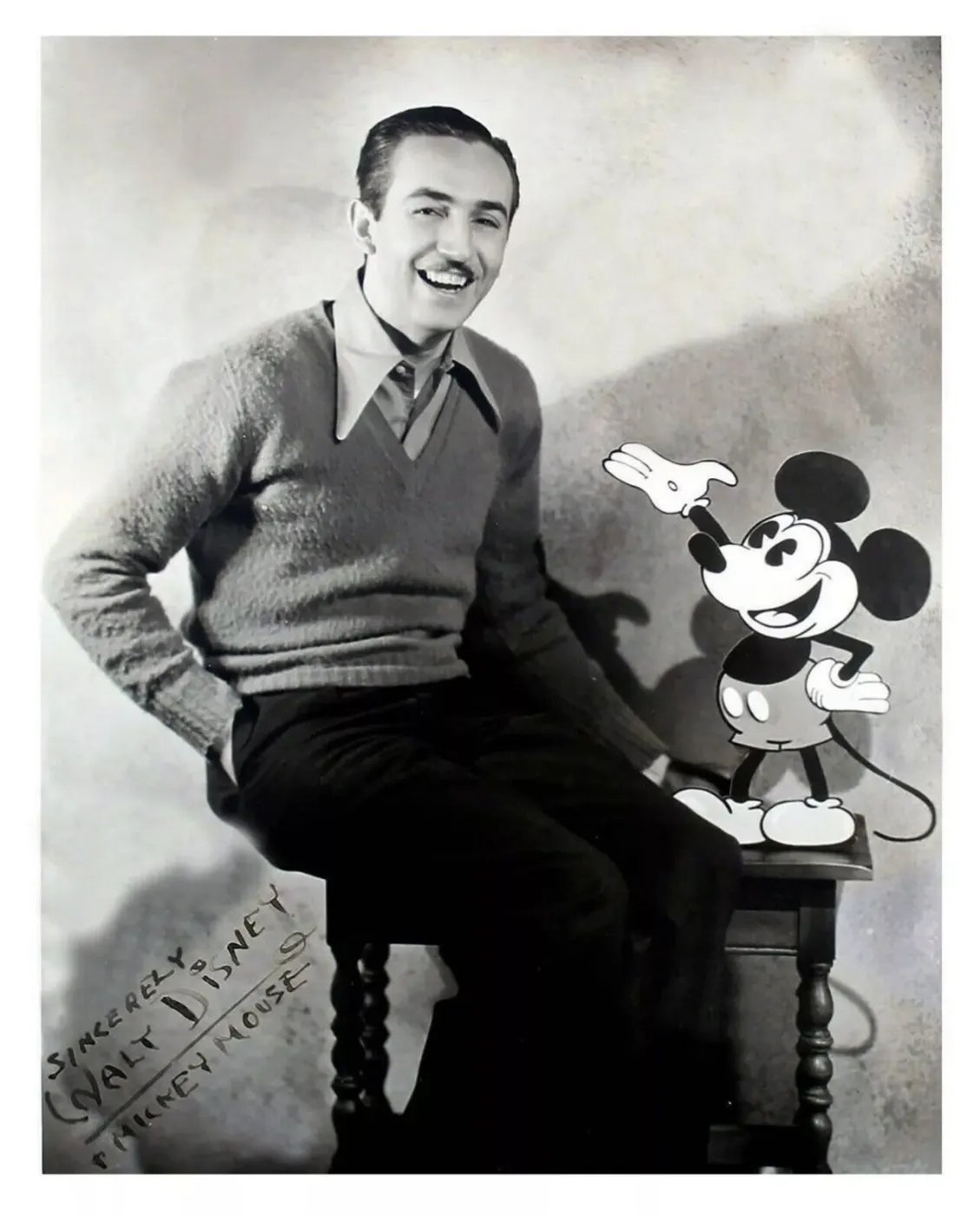
Walter Elias Disney was born on 5 December 1901 in Chicago, Illinois. He was the fourth son of Elias and Flora Disney. His older brothers were Herbert, Raymond, and Roy. A little sister, Ruth, came two years later.
His father, Elias, was a hard, serious man. He had been born in the village of Bluevale in Ontario, Canada. The family had come there from Ireland in the 1830s. Elias tried many jobs. He was a carpenter, an orange grower, and a builder. He never stayed rich for long, and he believed in strict rules.
In 1906, when Walt was four, the family moved to a farm near Marceline, Missouri. For the rest of his life, Walt would talk about Marceline as if it were a kind of paradise. There were apple trees, pigs, horses, and a creek. A train line ran through town. Walt watched the trains go by and dreamed of riding them.
The farm did not last. Elias became sick, and the family sold the land in 1911. But the main street of Marceline stayed in Walt's head. Many years later, when he built Main Street, U.S.A. at Disneyland, people who had visited Marceline said they could see the resemblance.
Kansas City: a paper route before dawn
The Disneys moved to Kansas City, Missouri, in 1911. Elias bought a newspaper delivery route. He put his young sons to work on it, and he did not pay them.
For about six years, Walt got up around three thirty in the morning, in rain, heat, and snow. He delivered the Kansas City Star and Times before school. Sometimes he was so tired that he fell asleep in a warm hallway on his route. He later said he had nightmares about missed newspapers for the rest of his life.
Walt's older brother Roy was eight years older. Roy was calm, careful, and good with money. When things were bad at home, Roy looked out for Walt. That bond would become the most important business partnership in the Disney story. Walt dreamed. Roy found ways to pay for the dreams.
In 1917 the family moved back to Chicago. Walt went to McKinley High School and drew cartoons for the school paper. He also took night classes at the Chicago Academy of Fine Arts. He wanted to be a newspaper cartoonist.
France, an ambulance, and a drawing habit
When the United States entered World War I, Walt wanted to go. Roy had already joined the Navy. Walt was only sixteen, too young for the army. So he joined the Red Cross ambulance corps. He changed the year on his birth date to make himself look older.
By the time he reached France in late 1918, the fighting had ended. He spent close to a year driving ambulances and trucks for the Red Cross. He came home in 1919 with money saved and a clear goal. He would not go back to school. He would become an artist.
Back in Kansas City, he got a job at a commercial art studio called Pesmen-Rubin. There he met another young artist named Ub Iwerks. Ub was shy and quiet, but he could draw faster and cleaner than almost anyone. The two became friends. When both lost their jobs, they started their own tiny art business together. It lasted only a short time.
Then Walt found a job at the Kansas City Film Ad Company. The company made short ads that played in movie theaters before the main film. Here Walt first saw animation up close. As he later told an interviewer, the figures were cut out of paper, and the joints were pinned so they could be moved a little at a time in front of the camera.
Walt borrowed a camera and began experimenting at night in his family's garage.
Laugh-O-Gram: first studio, first bankruptcy
Walt's night experiments turned into short cartoons called Newman Laugh-O-grams. They were local jokes about Kansas City, shown at the Newman Theatre. People liked them. In 1922, at age twenty, Walt formed his own company, Laugh-O-Gram Films.
He hired young artists, including Ub Iwerks. They made modern versions of fairy tales like Little Red Riding Hood and Puss in Boots. The work was clever. The business was not. A distributor that had agreed to buy the cartoons went broke and never paid in full.
Money ran out fast. Walt could not pay rent. He slept in the studio. He later said he lived on cold beans and bread.
One of his last projects in Kansas City was a short film called Alice's Wonderland. It mixed a real little girl with cartoon characters. It was never finished by the company, because Laugh-O-Gram filed for bankruptcy in 1923.
Walt was twenty-one. He had failed. He sold his camera, bought a one-way train ticket, and left for California with a cardboard suitcase and about forty dollars.
Hollywood, Roy, and Alice
Walt arrived in Los Angeles in July 1923. At first, he wanted to be a live-action movie director. Nobody hired him. So he went back to what he knew.
Roy was already in California, recovering from tuberculosis at a veterans hospital. Walt sent the unfinished Alice film to a New York distributor named Margaret Winkler. She offered a contract for a series of Alice Comedies. Walt went to Roy's bedside late at night and begged him to join. Roy agreed.
On 16 October 1923, the brothers started the Disney Brothers Cartoon Studio. Walt soon brought Ub Iwerks and other Kansas City artists west.
The Alice Comedies ran for about four years. They were not great art, but they paid the bills. The studio grew. In 1926 the brothers moved to a bigger building on Hyperion Avenue, and changed the name to Walt Disney Studio.
Walt also hired a young woman named Lillian Bounds to ink and paint cartoon drawings. They married on 13 July 1925. Lillian was practical and funny. She teased Walt about his wild ideas, but she stood by him through every risky bet. They would later have a daughter, Diane, and adopt a second daughter, Sharon.
Oswald: the rabbit he lost
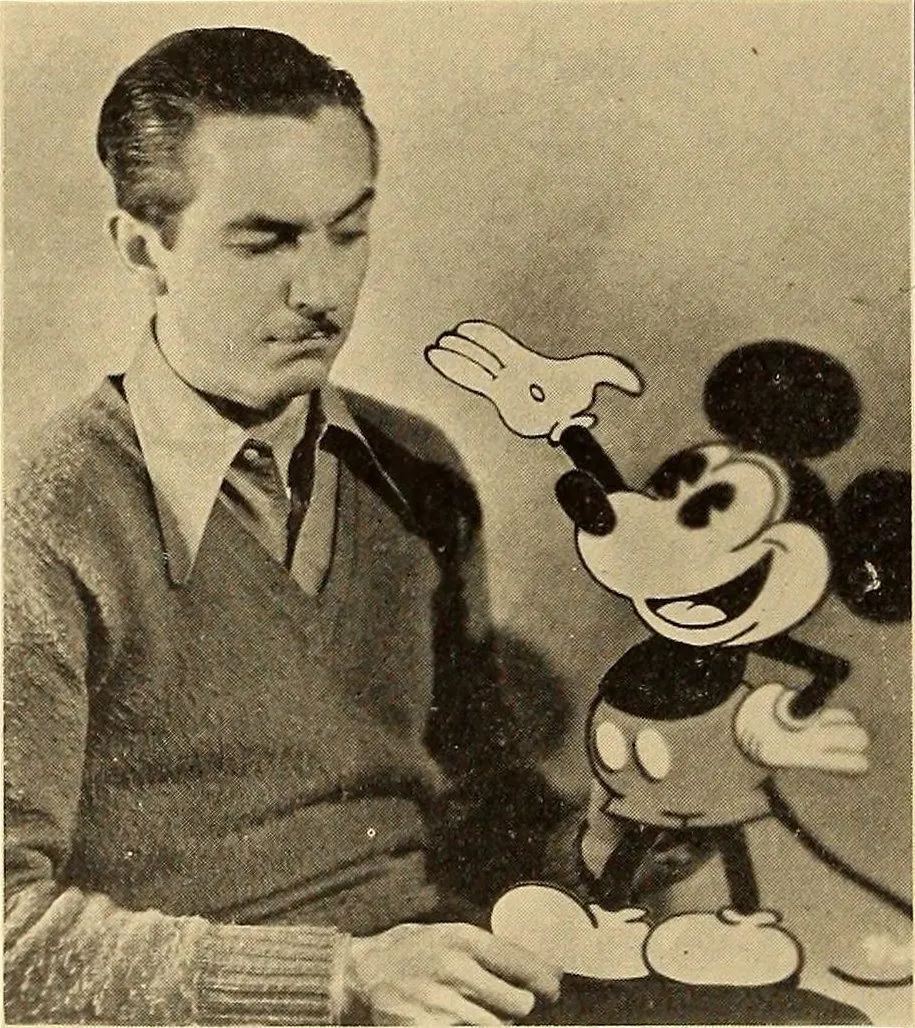
By 1927, the Alice series was wearing out. Margaret Winkler's husband, Charles Mintz, now ran her business. Mintz told Walt that Universal Pictures wanted a new cartoon character. It could not be a cat, because there were already too many cartoon cats.
Walt and Ub came up with a rabbit. They called him Oswald the Lucky Rabbit. Universal signed on in March 1927. Walt worked hard to give Oswald a real personality. Oswald was not just a funny shape. He had moods, wants, and a way of reacting. That idea, a cartoon character who feels like a person, would become Walt's secret weapon.
In February 1928, Walt and Lillian took a train to New York. Walt planned to ask Mintz for more money per cartoon. Instead, Mintz offered less. Then he revealed something worse. He had already signed most of Walt's animators to work for him directly. And under the contract, Universal owned Oswald. Walt did not.
Walt had built the character. He had trained the artists. Now both were gone. Only Ub Iwerks and a few loyal workers stayed.
Walt took one hard lesson from New York. For the rest of his life, he would own what he created. Every character, every film, and every idea would belong to the Disney company. That rule shaped everything that came after.
Almost eighty years later, in 2006, the Walt Disney Company finally got Oswald back. In an odd trade, Disney let sportscaster Al Michaels leave its ESPN network for NBC, and NBC Universal handed over the rights to the old rabbit.
A mouse on the train home
The ride home from New York was long. According to the story Walt told for the rest of his life, he spent it thinking about a new character. He wanted something simple that anyone could draw and love. He settled on a mouse.
Walt said he first wanted to call the mouse Mortimer. Lillian thought that sounded too stuffy. She suggested Mickey. Historians debate how much of the train story is polished memory. What is certain is that by the spring of 1928, Walt and Ub were working on a mouse in secret.
Ub did most of the drawing. He could draw hundreds of pictures a day. Mickey was built from circles: a round head, two round ears, a round body. That made him fast to animate. Walt gave Mickey his personality: cheeky, brave, a little mischievous, and always hopeful.
The first Mickey cartoon was called Plane Crazy. It was a silent film about Mickey trying to fly like Charles Lindbergh. A test audience saw it, but no distributor wanted to buy it. A second silent Mickey film, The Gallopin' Gaucho, also struggled to find a buyer.
Then Walt saw where the movie business was heading. In late 1927, a film called The Jazz Singer had brought spoken words to the big screen. Audiences were wild about sound. Walt decided that his third Mickey cartoon would not just have music added later. It would be built around sound from the very start.
Steamboat Willie and the sound of a whistle
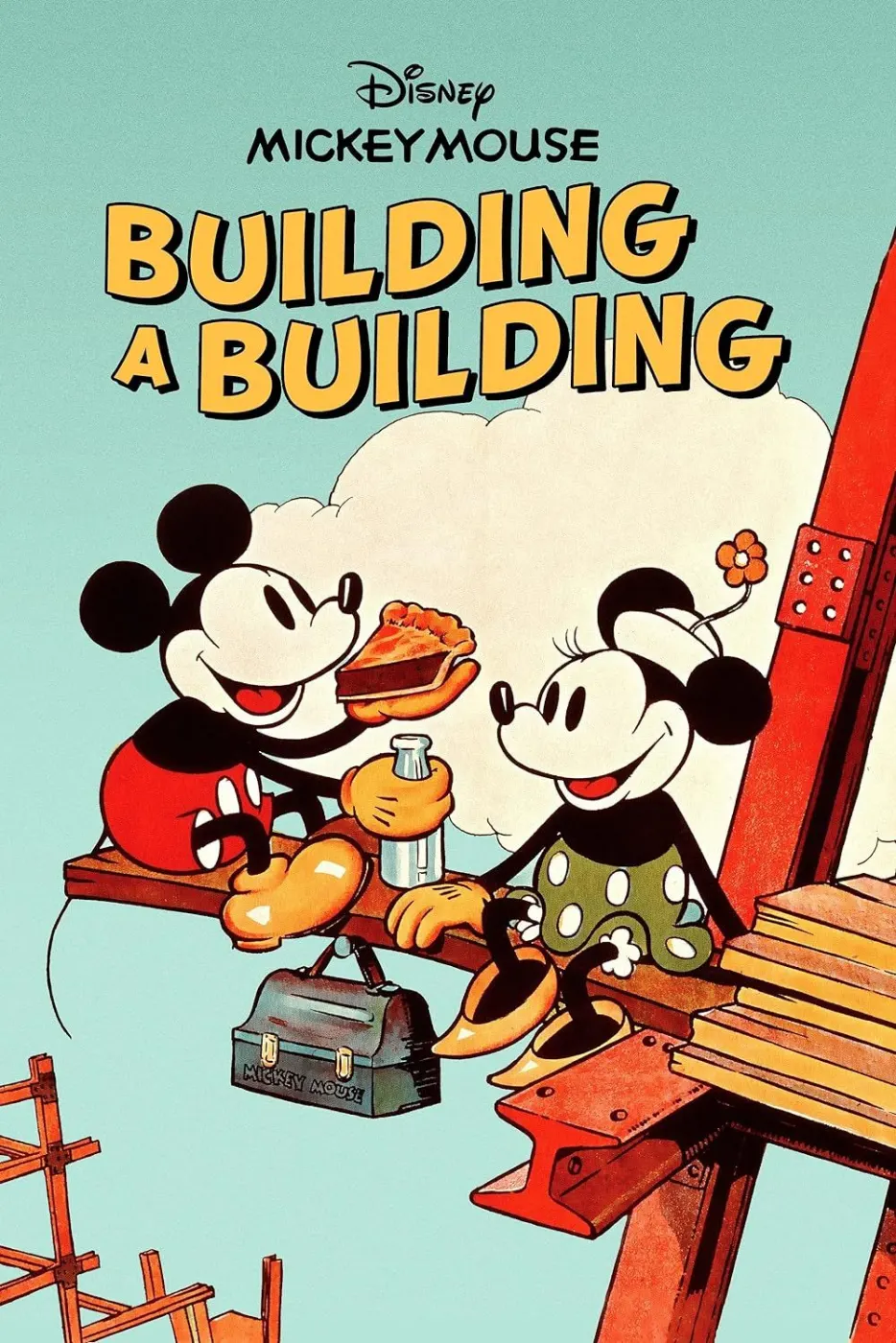
Making sound match a cartoon in 1928 was very hard. There was no easy way to mix recordings. As Walt later explained, everything had to be recorded at once. The orchestra, the sound effects, and the voices all had to play together while the cartoon ran, perfectly in time.
Walt's team worked out a clever system. They marked the film with a steady beat, so every musician and sound effects player knew exactly when to bang, whistle, or pop. The first recording session in New York went badly. The band leader would not follow the beat. Walt had to pay for a second session. To raise the money, he asked Roy to sell his beloved car, a Moon Cabriolet.
The second session worked. Steamboat Willie opened at the Colony Theatre on 18 November 1928. Critics loved it. Within weeks, Mickey Mouse was famous.
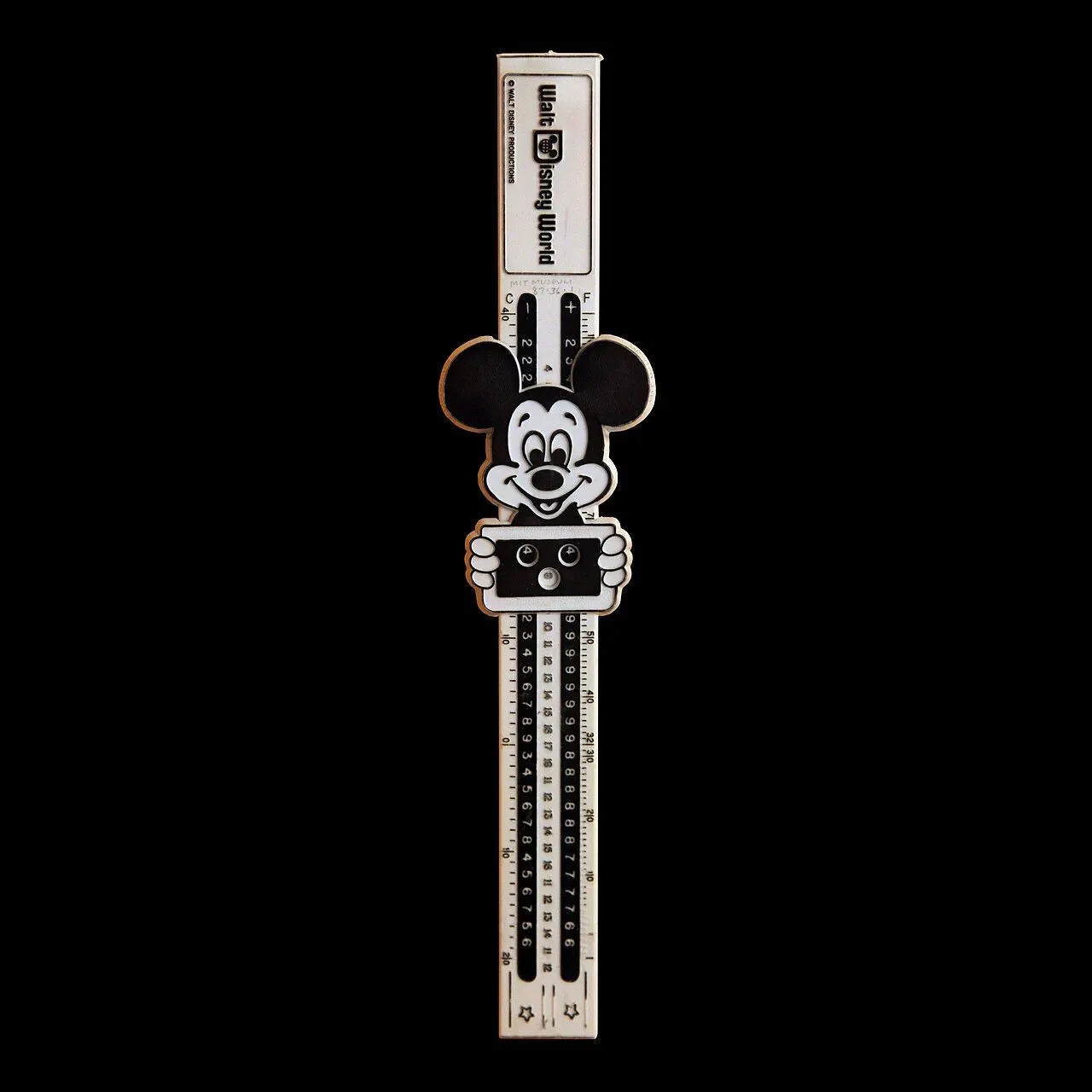
Money followed, though slowly. In 1929 a New York businessman paid Walt three hundred dollars to put Mickey on school writing tablets. It was the start of licensing, the business of letting other companies use a character on their products. Later, a salesman named Kay Kamen took charge of Disney merchandise. In 1933 the Ingersoll company sold Mickey Mouse watches by the millions during the Great Depression. The watches helped save the Ingersoll company.
Walt himself performed Mickey's squeaky voice for almost twenty years, until 1947.
Silly Symphonies, color, and three little pigs
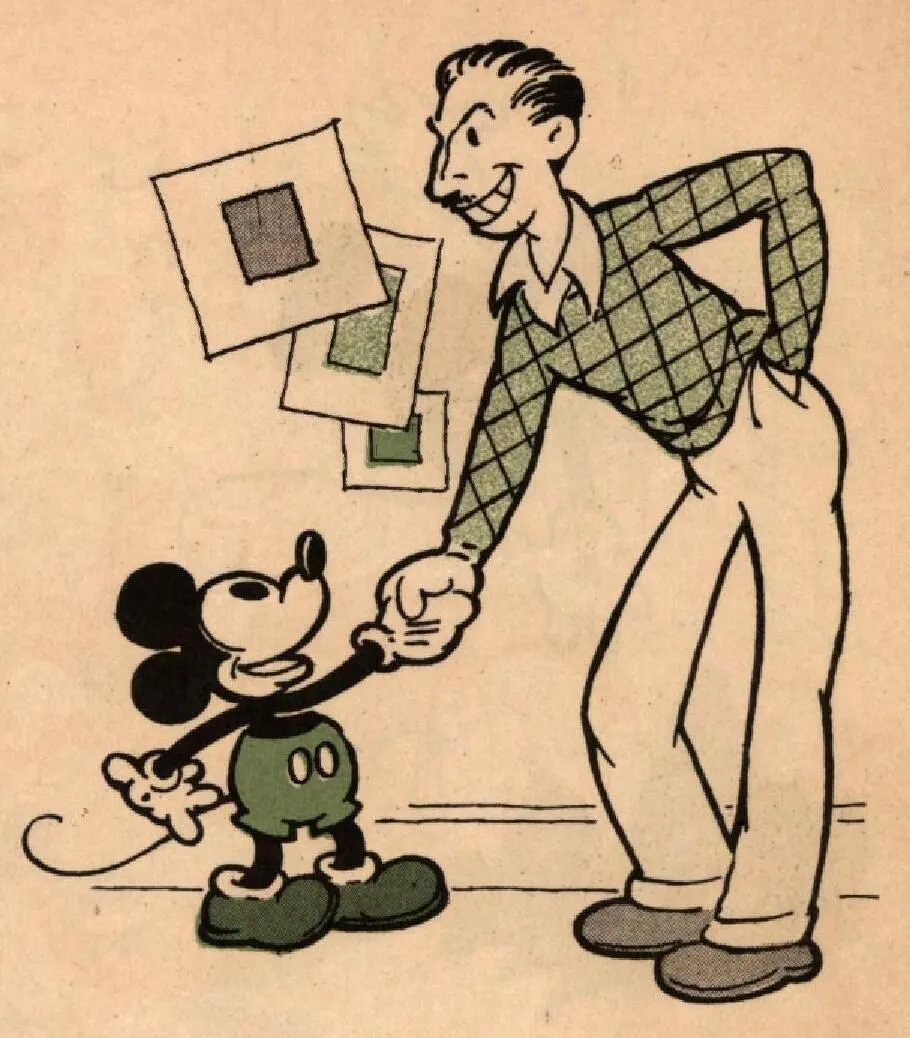
Walt was not happy to make only Mickey cartoons. In 1929 he started a second series called Silly Symphonies. These were short films built around music. The first, The Skeleton Dance, showed skeletons dancing in a graveyard.
In 1932 Walt made a deal with the Technicolor company to use its new three-color process in cartoons. He paid for exclusive rights for a period of time. The first result was Flowers and Trees. It became the first cartoon to win the new Academy Award for animated short films. That same year, Walt got a special honorary Oscar for creating Mickey Mouse.
In 1933 came Three Little Pigs. Its song, Who's Afraid of the Big Bad Wolf?, became a national hit. In the middle of the Great Depression, people sang it as a way of saying they would not give up. Theaters kept the cartoon playing for months.
The studio kept growing. Walt paid for night art classes for his animators. He wanted them to study how real people and animals move. As he later put it in an interview, the art schools of the time dealt with still figures, and his artists needed to learn motion, action, and reaction. He was preparing them for something much bigger.
Disney's Folly
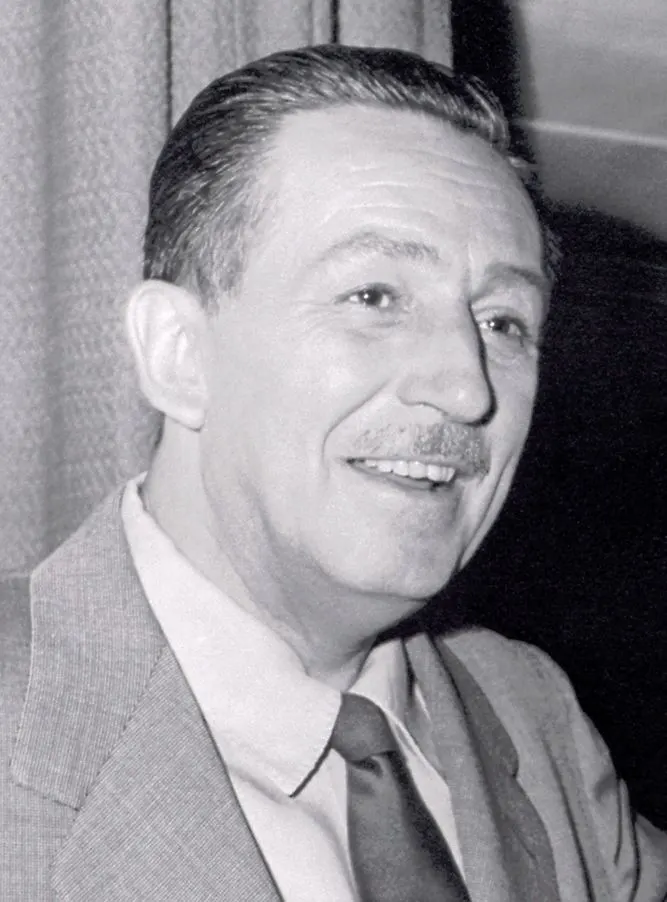
One night in 1934, Walt gave a group of his top animators fifty cents each and sent them out for dinner. He asked them to come back to the sound stage afterward. When they returned, Walt stood in front of them and acted out a whole story, playing every part. He was the wicked queen. He was the dwarfs. He was the young princess.
The story was Snow White and the Seven Dwarfs. Walt told his team they would make it into a full-length cartoon, about eighty minutes long.
Many people in Hollywood thought this was madness. A short cartoon was a snack before the real movie. Who would sit through a cartoon for more than an hour? Some said the bright colors would hurt people's eyes. The press began calling it Disney's Folly.
Walt did not care. The first plan was to spend a few hundred thousand dollars. As the work went on, the cost kept rising. By the end, Snow White cost about 1.5 million dollars, a huge sum in the Depression. The studio grew to more than six hundred workers. Hundreds worked only on this one film.
To give scenes more depth, the studio built a new machine called the multiplane camera. It filmed layers of painted glass at different distances, so a forest could look deep and real. The team tested it first on a short cartoon, The Old Mill, which won an Oscar.
When the money ran out, Roy went to the Bank of America. The bankers wanted to see the unfinished film first. Walt showed a banker named Joseph Rosenberg a rough cut, full of pencil drawings. Rosenberg watched in silence. At the end, he said the film would make a lot of money, and he approved the loan.
Premiere night at the Carthay Circle
Snow White and the Seven Dwarfs premiered on 21 December 1937 at the Carthay Circle Theatre in Los Angeles. Movie stars filled the seats. Walt was nervous. He had put, as he said later, the family fortune into the picture.
The audience laughed at the dwarfs. They gasped at the queen's change into a witch. When Snow White seemed to die, and the dwarfs cried beside her, grown adults in the theater cried too. At the end, the crowd stood and cheered.
The film opened across America in early 1938. It became the most successful sound film up to that time, for a short while. Each dwarf had a clear personality: Doc, Grumpy, Happy, Sleepy, Bashful, Sneezy, and Dopey. That was the Walt Disney touch. The characters felt real.
In 1939, Walt received a special Academy Award for Snow White. It was one normal-sized Oscar statue and seven tiny ones, one for each dwarf. Ten-year-old child star Shirley Temple handed it to him.
With the money, Walt built a large new studio in Burbank, California. It had air conditioning, sound stages, and a campus feel. He thought his artists would be happy there forever.
Pinocchio, Fantasia, and almost broke
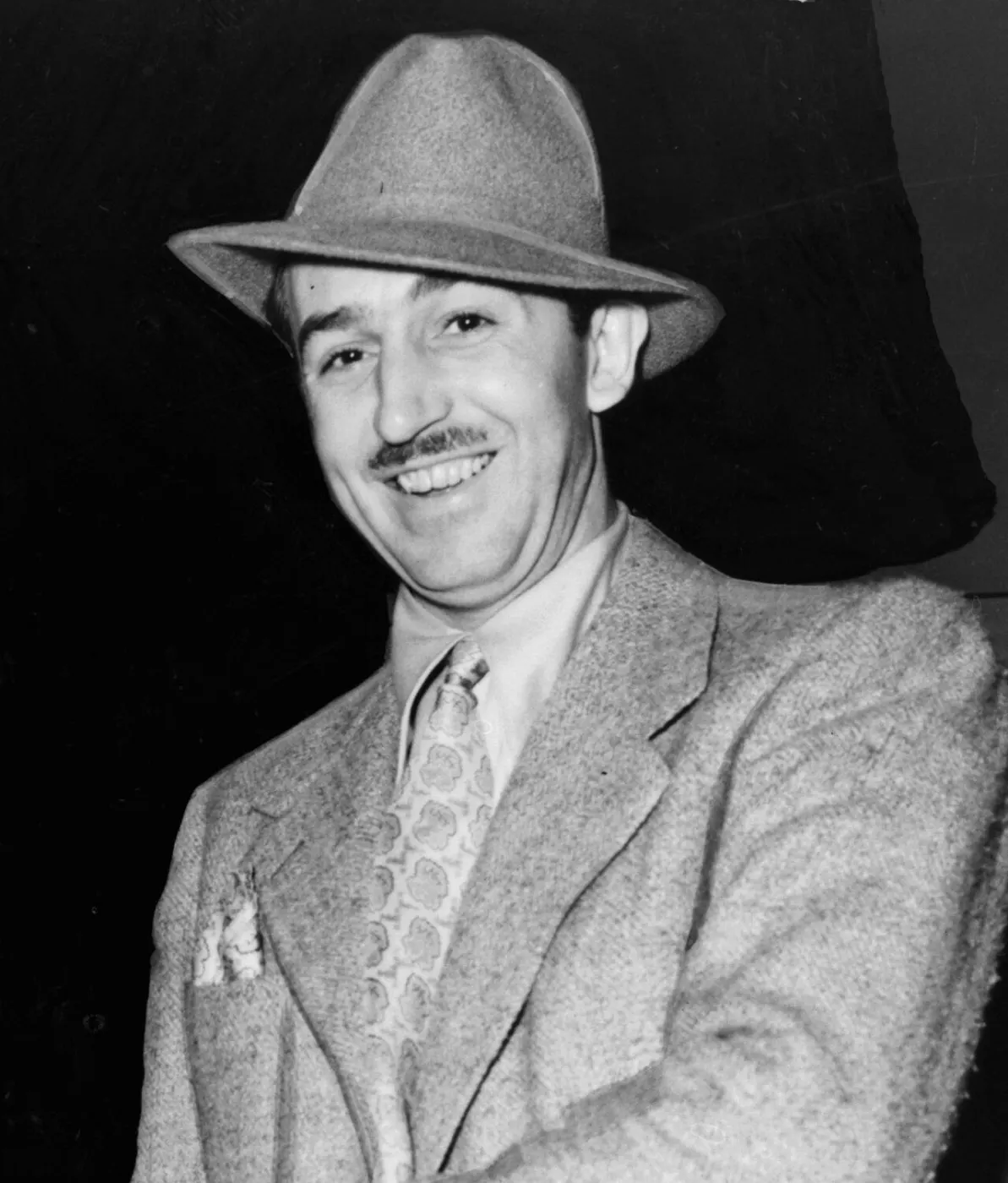
Walt did not play it safe after Snow White. He pushed his team to be even more ambitious.
Pinocchio came out in February 1940. Many critics today think it is one of the most beautiful animated films ever made. The underwater scenes, the whale, and the song When You Wish Upon a Star were stunning. But World War II had started in Europe in 1939. Disney lost many foreign markets, where a large part of its income came from. Pinocchio cost more than Snow White and lost money at first.
Fantasia came out in November 1940. It began as a single short film. Walt wanted to make The Sorcerer's Apprentice with Mickey Mouse. At a dinner, he met the famous conductor Leopold Stokowski, who offered to conduct the music. The short grew into a full concert film with eight pieces of classical music.
Fantasia was a bold experiment. It was also very expensive, and many theaters could not show it the way Walt wanted. In the interview he gave years later, Walt joked that he had always been known as a perfectionist, until he met Stokowski.
Two years after Snow White made him famous, Walt said, he was almost broke. The studio owed banks millions. In 1940 the company sold stock to the public for the first time, to raise money.
Burbank, the strike, and a hard year
The move to Burbank changed the studio. It was now a large company with more than a thousand workers. Walt had once known everyone by name. Now there were layers of managers. Pay was uneven. Some top artists earned a lot. Many assistants earned little.
In 1941, workers organized with a cartoonists union. When Walt refused to accept the union in the way the workers demanded, and fired union leaders, hundreds of employees went on strike in late May. Picket lines stood outside the studio gates. Some strikers held signs showing cartoon characters.
The strike dragged on through the summer, and federal mediators helped end it. The union was recognized. Walt felt personally betrayed by workers he considered part of his family. Some strikers felt Walt had treated them unfairly. Historians still describe the strike from both sides. What is clear is that the studio never felt quite the same afterward. Several talented artists left.
War work and South America
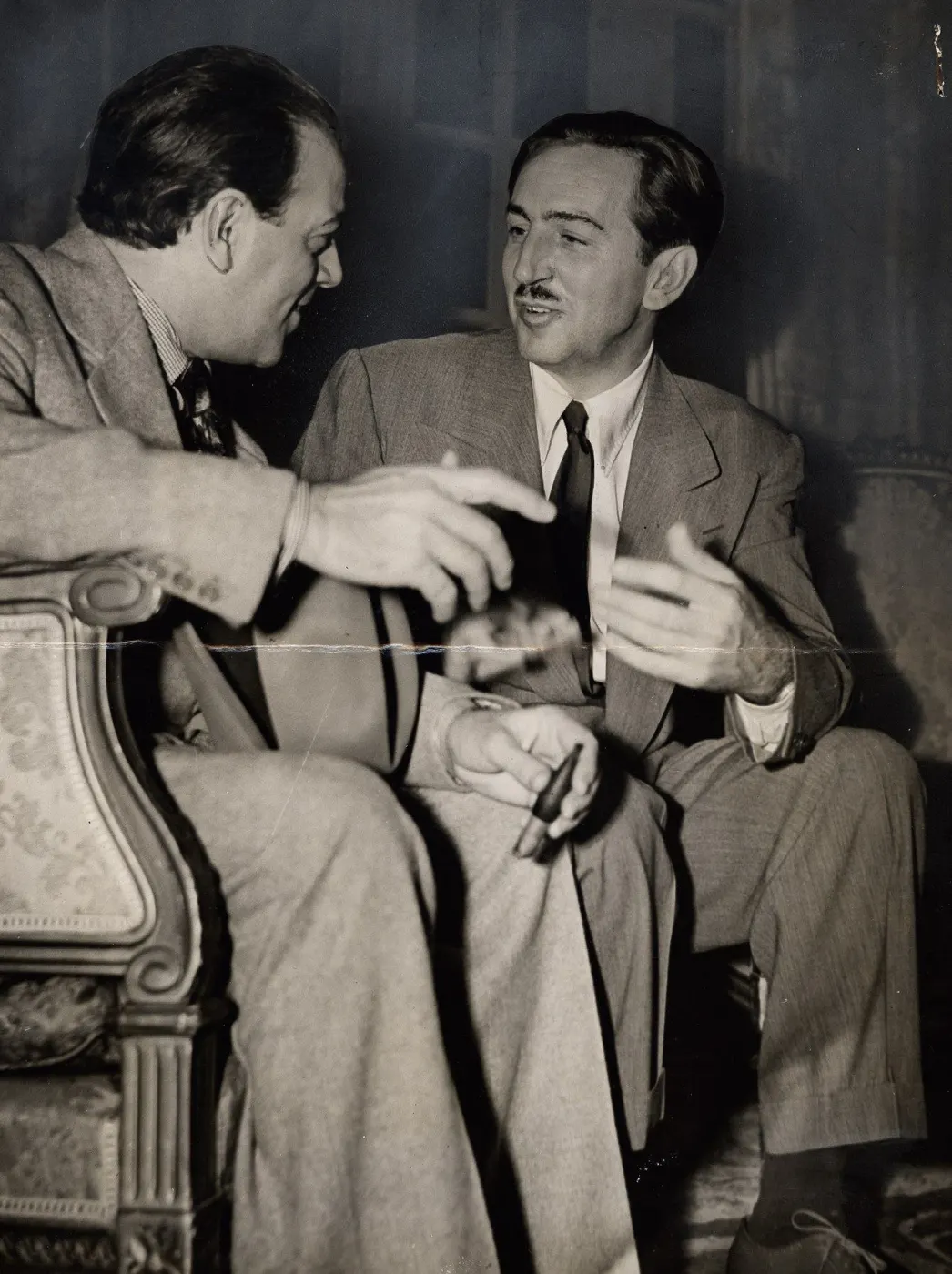
In 1941, while the strike was still going on, the U.S. government sent Walt and a small team of artists on a goodwill trip to South America. In Brazil, Walt met the composer Heitor Villa-Lobos and other artists. The trip led to two films, Saludos Amigos in 1942 and The Three Caballeros in 1944. They introduced a Brazilian parrot named José Carioca and mixed cartoons with live action and music.
Then America entered World War II in December 1941. The day after the attack on Pearl Harbor, U.S. Army troops moved into the Burbank studio. They used part of it to guard nearby aircraft factories.
For the next few years, most of the studio's work was for the war. Disney made training films for soldiers and sailors, teaching things like aircraft recognition and first aid. It made short films encouraging people to pay taxes and buy war bonds. Artists drew hundreds of free insignia designs for military units. Donald Duck starred in several war cartoons.
The war work kept the studio open, but it earned little profit. When the war ended in 1945, Disney was in debt and struggling to find its way back to feature films.
After the war, in 1947, Walt testified before the House Un-American Activities Committee in Washington. He appeared as a friendly witness and named a few former employees he believed were involved with communist groups. His testimony has been debated ever since. Supporters saw him as a patriot. Critics saw him as settling scores from the strike.
Cinderella and the comeback
By the late 1940s, Walt needed a hit. He and his team went back to what had worked: a classic fairy tale, a kind heroine, funny animal sidekicks, and memorable songs.
Cinderella opened in February 1950. It was a big success. The money helped the studio pay off debt and gave Walt room to try new things again.
More animated classics followed: Alice in Wonderland in 1951, Peter Pan in 1953, Lady and the Tramp in 1955, and Sleeping Beauty in 1959.
Yet Walt was getting restless with animation. He left more of the daily cartoon work to his top animators, a group that later became known as the Nine Old Men. His mind was turning to a new idea, one he had been thinking about for years.
A bench in Griffith Park
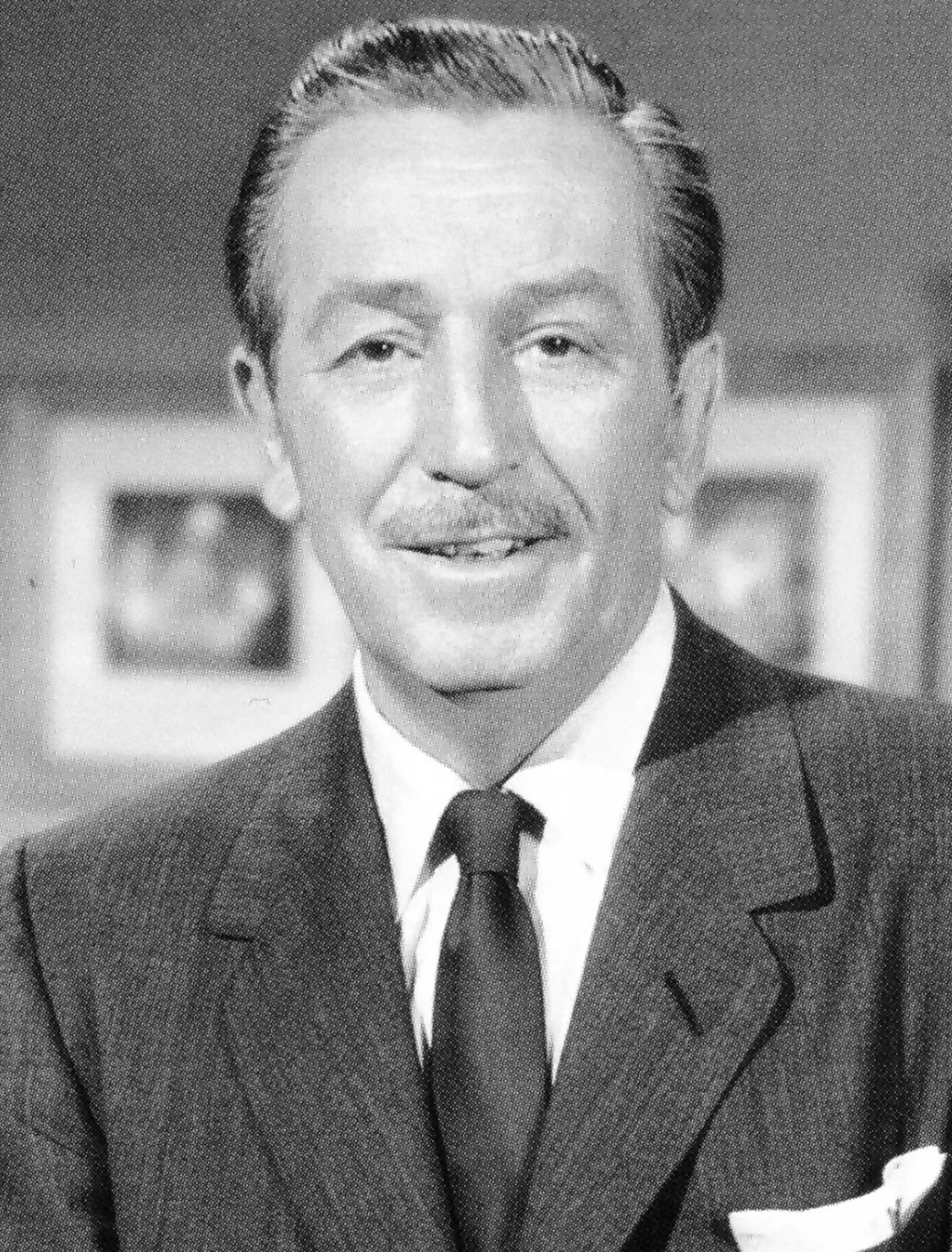
On Saturdays, Walt spent time with his daughters, Diane and Sharon. He called it Daddy's Day. He often took them to the merry-go-round in Griffith Park in Los Angeles.
As Walt later told it, he would sit on a bench eating peanuts while the girls rode. He looked around and felt something was missing. The parks of the time were dirty, and the rides were for children only. Parents just waited. He thought there should be a place where parents and children could have fun together.
Walt also loved trains. In the late 1940s he built a small backyard railroad at his home, big enough to ride. He called it the Carolwood Pacific. He started to sketch a little park with a train near the studio, where visitors could meet characters.
The idea kept growing. As Walt said in 1963, it took about fifteen years of starting over and throwing ideas away. In 1952 he formed a separate company to design it. It was called WED Enterprises, from his initials, Walter Elias Disney. Its designers later became known as Imagineers.
Roy was worried. The studio did not have the money for a giant park. Bankers thought amusement parks were a bad bet. Walt borrowed against his life insurance to keep planning.
Selling a park to television
Walt needed a partner with money. He found one in an unexpected place: television.
The big movie studios feared TV. They saw it as the enemy stealing their audience. Walt saw it as a giant advertising screen that came into every home.
In 1954, the young ABC television network agreed to help pay for the park. In return, Walt would make a weekly TV show for ABC. The show was called Disneyland. It started in October 1954. Walt himself hosted it, speaking directly to families in a warm, friendly voice.
Each week the show took viewers to one of the park's future lands: Adventureland, Frontierland, Fantasyland, and Tomorrowland. It let millions of families watch the park being built. By the time the gates opened, children across America were begging to go.
The land was a 160-acre orange grove in Anaheim, south of Los Angeles. Construction started in July 1954. The team had just one year to build a castle, a river, a jungle, a railroad, and a small-town Main Street.
17 July 1955
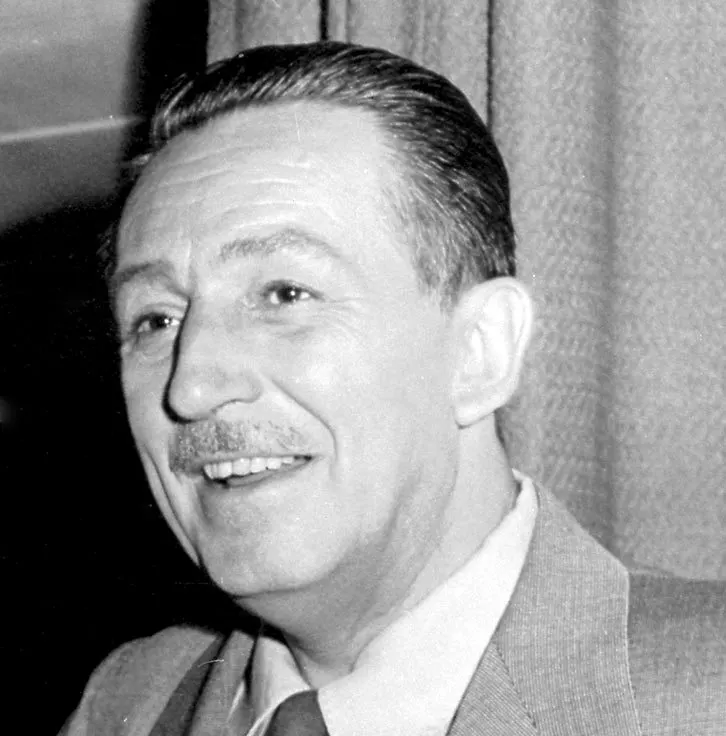
Disneyland opened on Sunday, 17 July 1955. It was meant to be a special preview day for invited guests and the press, broadcast live on ABC. Around ninety million people watched on television, a huge number at the time.
Things went wrong almost at once. Thousands of people showed up with fake tickets, so the park was badly overcrowded. It was extremely hot. New asphalt on Main Street was so soft that women's high heels sank into it. A plumbers strike meant there were few working water fountains. Some rides broke down. Restaurants ran out of food.
Workers later called it Black Sunday. But Walt stood in Town Square and read his dedication. To all who come to this happy place, welcome, he said. Disneyland would be a place where adults could relive fond memories of the past, and where the young could enjoy the challenge and promise of the future.
The problems were fixed within weeks. By the end of its first year, the park had welcomed millions of guests. Walt walked the park often, sometimes before it opened, checking every detail.
He also said something that became a Disney motto. Disneyland, he said, would never be completed. It would keep growing as long as there was imagination left in the world.
Coonskin caps, Mouseketeers, and rockets
The Disneyland TV show created stars of its own. In late 1954 and early 1955, it aired three episodes about the frontiersman Davy Crockett. Almost overnight, American boys wanted coonskin caps. Stores sold millions of them. The theme song topped the charts.
In October 1955, Disney started another TV show, The Mickey Mouse Club. It aired every weekday afternoon. Young performers called Mouseketeers wore hats with mouse ears. Those ears became one of the most famous souvenirs in the world.
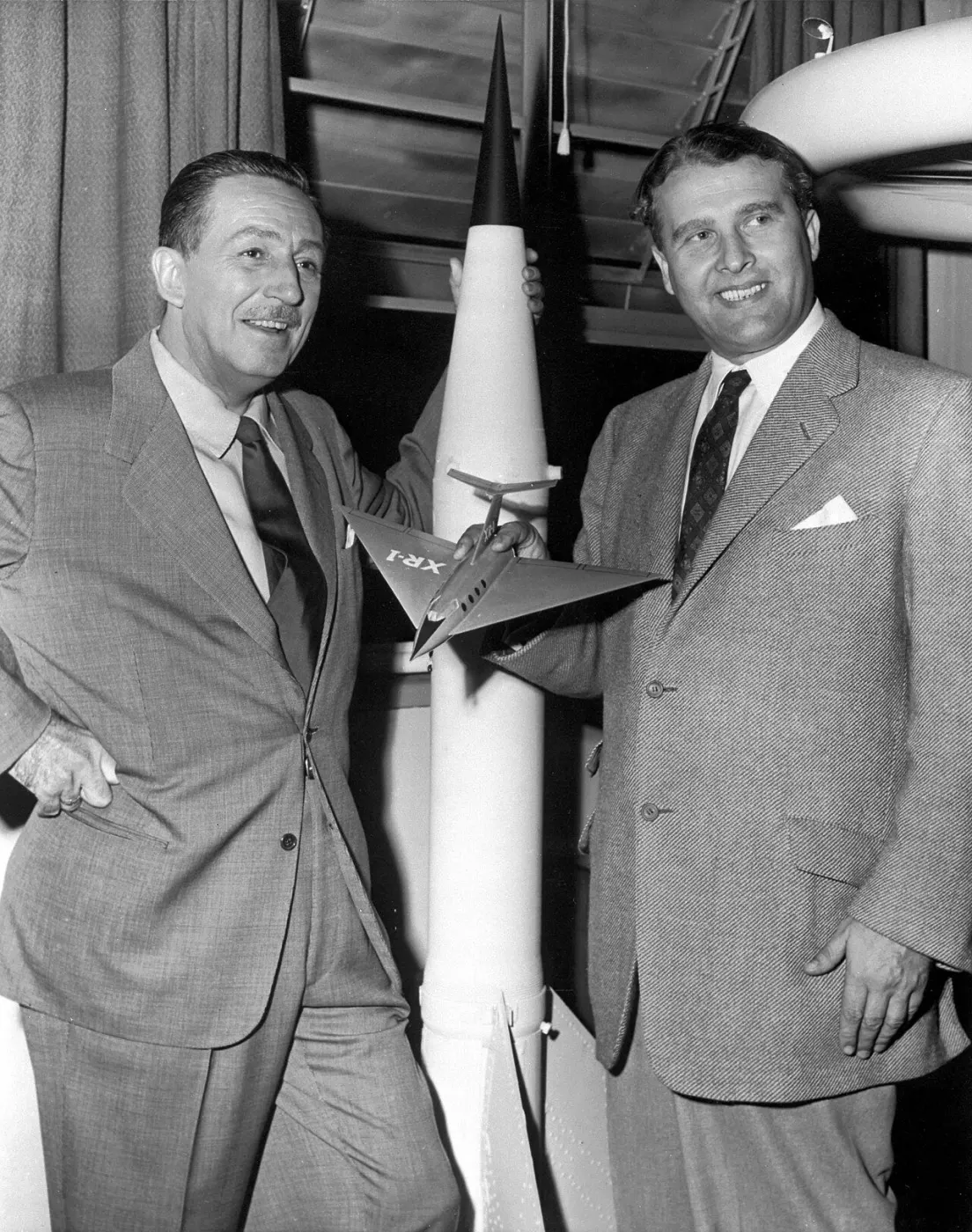
Walt also used television to teach. In 1955 his show aired Man in Space, made with the rocket scientist Wernher von Braun. It explained, with animation, how people might one day travel into space.
Walt now ran a studio, a theme park, a TV production business, a music label, and a huge merchandise operation. They all fed each other. A film created characters. The characters went on TV. TV sold park tickets. The park sold toys. Business writers today call this synergy. Walt drew a famous chart in 1957 showing exactly how each part helped the others.
How he worked
People who worked for Walt remembered two sides of him.
He could be warm, funny, and full of energy. He would act out stories for his artists, making faces and voices. He remembered small details from meetings weeks earlier. He wanted everyone to call him Walt, not Mr. Disney.
He could also be demanding and hard to please. He rarely handed out praise. His highest compliment was said to be a short remark: That will work. Artists learned to watch for a raised eyebrow that meant he was unhappy.
Walt did not draw much after the 1920s. His skill was different. He could see a whole story, a whole film, or a whole park in his mind, then get hundreds of people to build it. He studied every storyboard. He pushed for more and better, even when it cost more money than the studio had.
He was a heavy smoker for most of his life and worked long hours. Friends said he was happiest in the park, watching guests laugh.
1964: Poppins, the World's Fair, and a medal
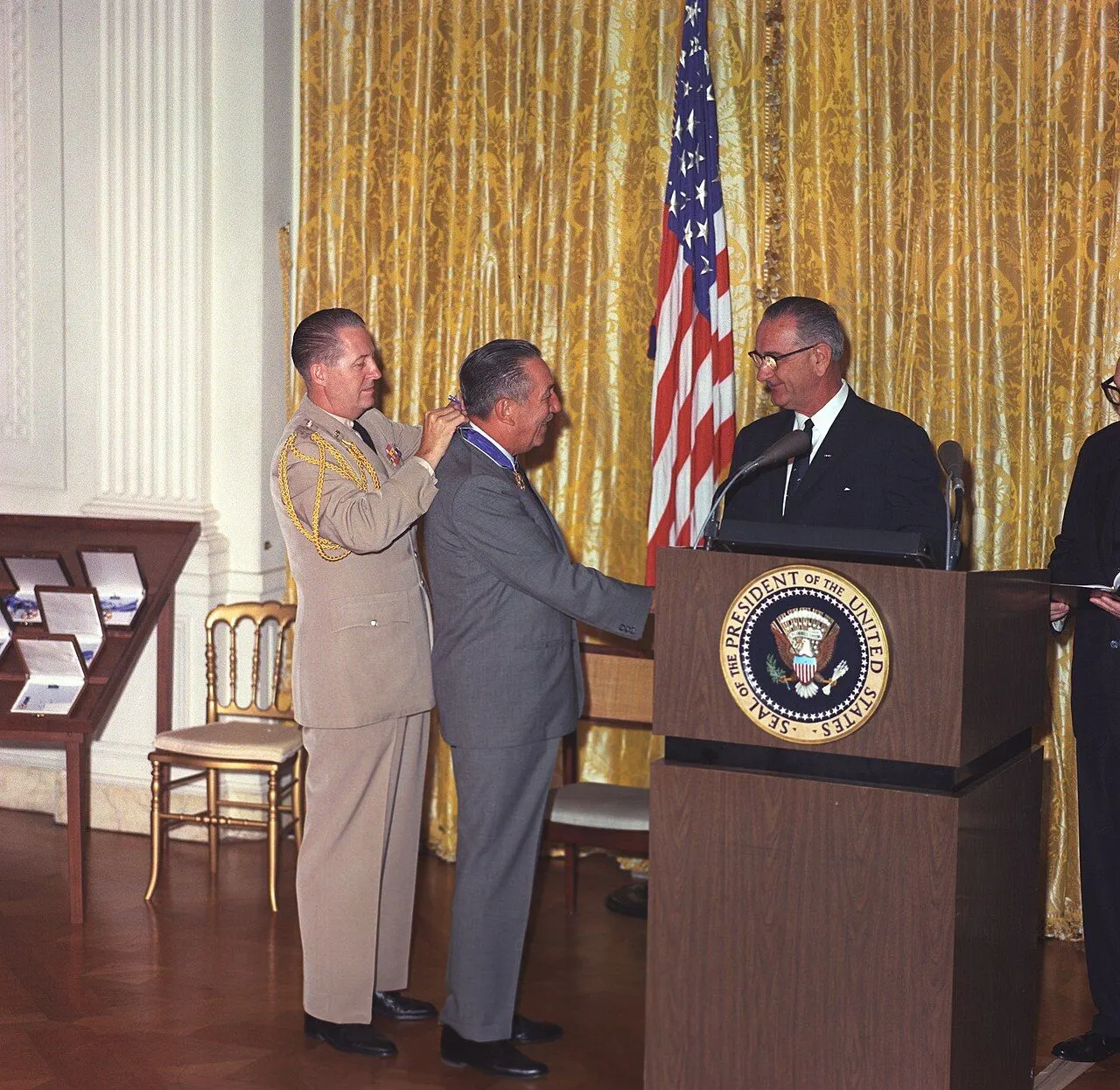
The year 1964 may have been the high point of Walt's career.
In August, Mary Poppins opened. It mixed live actors with animation, and it starred Julie Andrews and Dick Van Dyke. Walt had spent about twenty years convincing author P. L. Travers to let him film her books. The movie was a huge hit. It earned thirteen Oscar nominations and won five, including Best Actress for Andrews.
At the New York World's Fair of 1964 and 1965, Disney built four attractions for sponsors. They included it's a small world, a boat ride through the children of the world, and Great Moments with Mr. Lincoln. In that show, a moving, speaking figure of Abraham Lincoln rose from his chair. Disney called the technology audio-animatronics.
On 14 September 1964, President Lyndon B. Johnson presented Walt with the Presidential Medal of Freedom at the White House. It is the highest honor the country gives to a civilian.
The Florida Project
At Disneyland, cheap motels, bright signs, and tourist traps had grown up right outside the gates. For his next project, he wanted enough land to keep the outside world away.
In the early 1960s, Disney began quietly buying land near Orlando, Florida. The company used fake company names so sellers would not know Disney was behind it and raise prices. In the end it gathered about twenty-seven thousand acres, roughly twice the size of Manhattan.
A reporter in Orlando figured out the secret in October 1965. On 15 November 1965, Walt and Roy made it official at a press event with Florida's governor.
The park was only part of it. Walt was most excited about something he called EPCOT, the Experimental Prototype Community of Tomorrow. He did not mean a theme park. He meant a real city where about twenty thousand people would live and work. It would test new ideas in transportation, housing, and energy.
In a film recorded in October 1966, Walt explained the plan using maps and models. The city would be shaped like a wheel. Cars and trucks would run underground. Monorails and people movers would carry residents. The downtown would be covered and climate controlled. Walt said EPCOT would never be finished, because it would always be introducing new ideas.
The last months
In the fall of 1966, Walt filmed a short introduction for a showing of his movie Follow Me, Boys! He looked tired. He apologized for not being there in person and said he was busy shooting another picture. He praised a fifteen-year-old actor named Kurt Russell and predicted he had a great acting future. He told the audience to keep a handkerchief handy, because they would shed a few happy tears.
Archivists at the Walt Disney Archives later confirmed that the EPCOT film was among the last things Walt ever recorded.
In early November 1966, doctors found a tumor in his left lung. He had surgery, and much of the lung was removed. The cancer had spread. Walt went back to the studio briefly and kept working on plans for Florida and a new film, The Jungle Book.
He returned to St. Joseph's Hospital, across the street from the studio, at the end of November. A well-known story says that from his hospital bed, Walt used the ceiling tiles as a map grid to explain the Florida layout to Roy.
Walt Disney died on 15 December 1966, ten days after his sixty-fifth birthday. He was cremated and buried at Forest Lawn Memorial Park in Glendale. A popular rumor says his body was frozen. That is a myth.
Roy finishes the job
Roy had planned to retire. Instead, he stayed on to finish his brother's last dream. He insisted that the Florida resort be named Walt Disney World, so people would always remember who dreamed it.
Walt Disney World opened on 1 October 1971. At the dedication, Roy said it was a tribute to the philosophy and life of his brother. Roy died about two months later, in December 1971.
Without Walt, the company struggled for years to decide what he would have done. The EPCOT city was never built as he imagined it. Instead, EPCOT Center opened in 1982 as a theme park about technology and world cultures.
World impact
Walt Disney holds the record for the most Academy Awards won by one person: twenty-two competitive Oscars from fifty-nine nominations, plus four honorary awards. Counting differently, Disney archivists have cited thirty-two Oscars in total.
He showed that cartoons could be feature films that make adults cry. He helped turn television into a partner for movies. He invented the modern theme park, where every part is designed around a story. His idea of linking films, TV, parks, and products shaped how entertainment companies around the world still work.
He also has critics. Some early Disney cartoons and films include racist images and stereotypes that the company now warns viewers about on its streaming service. Historians keep debating his handling of the 1941 strike and his 1947 testimony. A full picture of Walt includes both his genius and his flaws.
2026 snapshot: a company still carrying his name
In 2023 the company marked its hundredth birthday, called Disney100. On 1 January 2024, the earliest version of Mickey, from Steamboat Willie, entered the public domain in the United States. Anyone may now use that exact 1928 cartoon, though Disney still holds trademarks on Mickey.
On 17 July 2025, Disneyland turned seventy. For the anniversary, the park opened a show called Walt Disney: A Magical Life. It features an audio-animatronic figure of Walt himself. His granddaughter Joanna Miller publicly criticized the figure as a robotic version of her grandfather. Other family members and the Walt Disney Family Museum supported it, saying Walt loved new technology.
In May 2025, Disney announced plans for a new resort on Yas Island in Abu Dhabi with the local company Miral. It would be Disney's seventh resort and its first in the Middle East.
In 2026, the company named a new leader. Josh D'Amaro, who had run Disney's parks, was named chief executive in February 2026 and took over in March. Bob Iger stayed on as an adviser and board member until his planned retirement at the end of 2026. Dana Walden became president and chief creative officer.
Closing
Walt Disney failed often. His first studio went bankrupt. His first big character was taken from him. His two most ambitious early films lost money. His dream city was never built.
Yet each failure pushed him to try something bigger. Losing Oswald led to Mickey. Near bankruptcy led to Snow White. A tired afternoon on a park bench led to Disneyland.
Walt once said that all our dreams can come true, if we have the courage to pursue them. He spent his life proving that dreams take work, risk, and a brother willing to find the money.
Today, in parks on three continents, families stand on a Main Street that began in a small Missouri town. Somewhere nearby, a mouse in red shorts is waving.
Watch alongside this story
Short cuts from interviews, keynotes and launches. Each plays only the moment that matters.